

Considering an early withdrawal from your Gold IRA? Before you make that decision, it’s crucial to understand the potential financial impact. While Gold IRAs offer valuable portfolio diversification through precious metals, they’re still subject to the same IRS regulations as traditional retirement accounts. Early withdrawals can trigger significant penalties and tax consequences that might substantially reduce the amount you receive. This comprehensive guide explains everything you need to know about Gold IRA early withdrawal penalties, exceptions, and strategies to minimize their impact on your retirement savings.
Understanding Gold IRAs and Their Tax-Advantaged Nature
A Gold IRA is a self-directed Individual Retirement Account that allows you to hold physical precious metals like gold, silver, platinum, and palladium as part of your retirement portfolio. Like traditional IRAs, Gold IRAs offer tax advantages designed to help you build retirement wealth. However, these benefits come with specific rules about contributions, distributions, and penalties.
Gold IRAs function under the same tax framework as other IRAs, with two primary types:
Traditional Gold IRA
- Contributions may be tax-deductible
- Investments grow tax-deferred
- Withdrawals in retirement are taxed as ordinary income
- Early withdrawals before age 59½ face penalties
- Required Minimum Distributions (RMDs) begin at age 73
Roth Gold IRA
- Contributions made with after-tax dollars
- Investments grow tax-free
- Qualified withdrawals in retirement are tax-free
- Original contributions can be withdrawn without penalties
- No Required Minimum Distributions during your lifetime
While Gold IRAs offer the unique advantage of holding physical precious metals as a hedge against inflation and economic uncertainty, they’re still retirement accounts governed by IRS regulations. This means the same withdrawal rules and penalties apply, regardless of whether your IRA holds gold or traditional paper assets.
IRS Early Withdrawal Rules and Penalties

The IRS has established clear rules regarding early withdrawals from retirement accounts, including Gold IRAs. Understanding these regulations is essential before making any decisions about accessing your funds prematurely.
The 10% Early Withdrawal Penalty
The most significant penalty for early Gold IRA withdrawals is the 10% additional tax imposed by the IRS. This penalty applies to any distributions taken before you reach age 59½. This penalty exists to discourage using retirement funds for non-retirement purposes and to protect your long-term financial security.
Ordinary Income Taxes
In addition to the 10% penalty, early withdrawals from a traditional Gold IRA are subject to ordinary income taxes. The entire withdrawal amount is added to your taxable income for the year, potentially pushing you into a higher tax bracket. For high-income individuals, this could mean paying federal taxes of 22%, 24%, 32%, or even higher on the withdrawn amount.
Example: Cost of Early Withdrawal
If you withdraw $50,000 from your traditional Gold IRA at age 45:
- 10% early withdrawal penalty: $5,000
- Federal income tax (assuming 24% bracket): $12,000
- Potential state income tax (varies by state): $2,500 (5% example)
- Total cost: $19,500 (39% of withdrawal)
- Net amount received: $30,500
For Roth Gold IRAs, the rules are slightly different. You can withdraw your original contributions (but not earnings) at any time without penalties or taxes. However, any earnings withdrawn before age 59½ and before the account has been open for five years will be subject to both income taxes and the 10% penalty.
Need Help Understanding Your Gold IRA Options?
Our financial advisors specialize in precious metals retirement accounts and can help you navigate the complex rules around withdrawals and penalties.
Exceptions to the Early Withdrawal Penalty
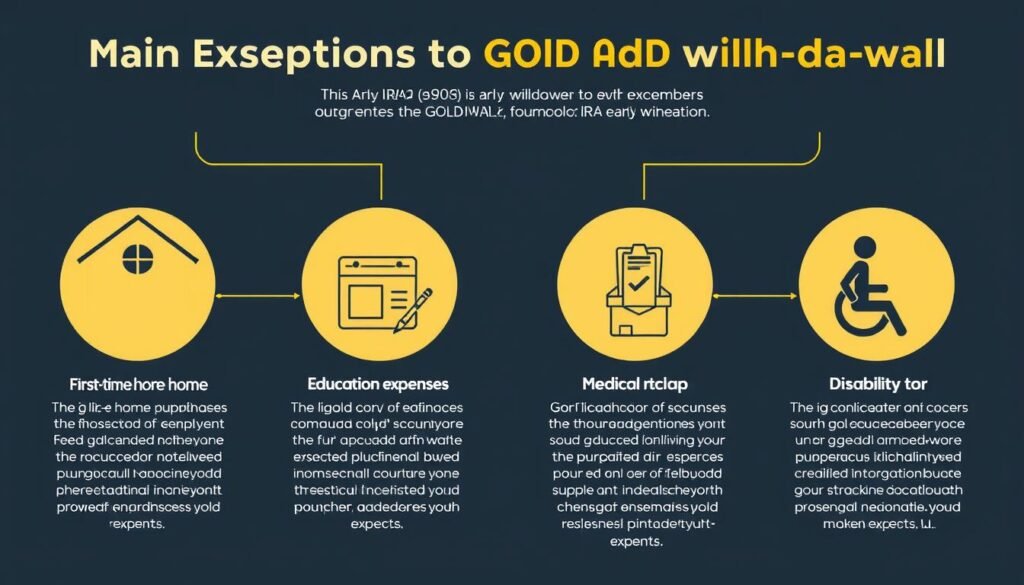
The IRS recognizes that certain life circumstances may necessitate early access to retirement funds. As a result, they’ve established several exceptions to the 10% early withdrawal penalty. It’s important to note that while these exceptions may waive the 10% penalty, you’ll still owe ordinary income taxes on distributions from a traditional Gold IRA.
| Exception Type | Details | Maximum Amount | Documentation Required |
| First-time Home Purchase | For first-time homebuyers or those who haven’t owned a home in the past two years | $10,000 lifetime limit | Purchase agreement, settlement statement |
| Higher Education Expenses | Qualified expenses for you, spouse, children, or grandchildren | No limit, but must be qualified expenses | Tuition statements, receipts for qualified expenses |
| Medical Expenses | Unreimbursed medical expenses exceeding 7.5% of adjusted gross income | Amount exceeding 7.5% of AGI | Medical bills, insurance statements |
| Health Insurance Premiums | For unemployed individuals who received unemployment for 12+ consecutive weeks | Amount of premiums | Unemployment verification, premium statements |
| Disability | Total and permanent disability | No limit | Physician certification, disability determination |
| Birth or Adoption | Expenses related to birth or adoption of a child | $5,000 per child | Birth certificate, adoption papers |
| Substantially Equal Periodic Payments (SEPP) | Taking distributions as part of a series of substantially equal payments | Based on life expectancy calculation | IRS Form 5329, payment schedule |
Substantially Equal Periodic Payments (SEPP)
The SEPP exception (also known as Rule 72(t)) allows you to take penalty-free withdrawals from your Gold IRA before age 59½ if you commit to taking a series of substantially equal payments for at least five years or until you reach age 59½, whichever is longer. The payment amounts are calculated based on your life expectancy using one of three IRS-approved methods.
Important: While these exceptions can help you avoid the 10% penalty, they don’t exempt you from paying ordinary income taxes on traditional Gold IRA withdrawals. Additionally, you must file IRS Form 5329 to claim most of these exceptions.
Required Minimum Distributions (RMDs) and Their Timing

While early withdrawals concern taking money out too soon, Required Minimum Distributions (RMDs) involve the opposite issue – not taking enough money out of your retirement accounts after a certain age. For traditional Gold IRA owners, understanding RMD rules is crucial to avoid substantial penalties.
When RMDs Begin
For traditional Gold IRAs, you must begin taking RMDs by April 1 of the year following the year you turn 73 (for those born between 1951 and 1959). For those born in 1960 or later, RMDs must begin by April 1 of the year following the year you turn 75. After your first RMD, subsequent distributions must be taken by December 31 of each year.
Calculating Your RMD
The amount you must withdraw is calculated by dividing your Gold IRA balance (as of December 31 of the previous year) by a life expectancy factor provided in IRS tables. Your custodian may calculate this for you, but ultimately, ensuring the correct amount is withdrawn is your responsibility.
Penalties for Missing RMDs
The penalty for not taking your full RMD is substantial – 25% of the amount not withdrawn. This can be reduced to 10% if you correct the shortfall in a timely manner. This penalty is one of the steepest in the tax code, emphasizing how seriously the IRS takes these requirements.
Roth Gold IRA Advantage: Roth Gold IRAs are not subject to RMDs during the original owner’s lifetime. This makes them valuable tools for estate planning, as they can continue to grow tax-free throughout your life.
Comparing Traditional IRA and Gold IRA Withdrawal Penalties
Many investors wonder if Gold IRAs have different withdrawal rules or penalties compared to traditional IRAs. The truth is that the IRS treats both types of accounts similarly when it comes to early withdrawals, but there are some nuanced differences worth understanding.
Similarities
- Both are subject to the 10% early withdrawal penalty before age 59½
- Both offer the same penalty exceptions (first-time home purchase, education, etc.)
- Both traditional versions require RMDs starting at age 73
- Both Roth versions allow tax-free qualified withdrawals
- Both follow the same contribution limits ($7,000 for 2025, $8,000 if age 50+)
Differences
- Gold IRAs may have higher administrative fees and storage costs
- Physical gold withdrawal options (in-kind distributions) vs. cash only
- Valuation considerations for in-kind distributions of physical gold
- Potential liquidity challenges when selling gold to meet RMDs
- Market timing considerations when selling precious metals
In-Kind Distributions: A Unique Gold IRA Feature
One notable difference with Gold IRAs is the option for “in-kind” distributions, where you can take possession of the actual physical gold rather than selling it and taking cash. However, the fair market value of the gold at the time of distribution is still subject to the same taxes and potential penalties as a cash withdrawal. This valuation becomes your new cost basis if you later sell the gold.
“The physical nature of gold doesn’t change the tax treatment of IRA withdrawals. The IRS is concerned with the value being distributed, not the form it takes.”
Strategies to Avoid Penalties on Your Gold IRA

While early withdrawal penalties can be substantial, there are several legitimate strategies to access your Gold IRA funds while minimizing or avoiding penalties altogether. Here are some approaches to consider:
Rollovers and Transfers
One way to move your Gold IRA assets without triggering penalties is through rollovers or transfers to another qualified retirement account. The IRS allows:
- Direct transfers: Custodian-to-custodian transfers between IRAs have no limits and don’t trigger taxes or penalties
- 60-day rollovers: You can withdraw funds and redeposit them into another qualified account within 60 days without penalties (limited to once per 12-month period)
- Roth conversions: Converting a traditional Gold IRA to a Roth requires paying taxes but no penalties, and provides future tax-free growth
Qualified Distributions
Ensuring your withdrawals qualify for one of the IRS exceptions is another effective strategy. Keep detailed records and documentation to substantiate your qualification for exceptions like:
- Higher education expenses for yourself or family members
- First-time home purchase (up to $10,000 lifetime limit)
- Unreimbursed medical expenses exceeding 7.5% of your adjusted gross income
- Health insurance premiums during unemployment
Substantially Equal Periodic Payments (SEPP)
The SEPP program (Rule 72(t)) allows penalty-free withdrawals at any age if you commit to taking a series of substantially equal payments for at least five years or until you reach age 59½, whichever is longer. There are three IRS-approved calculation methods:
- Required Minimum Distribution method: Generally results in the smallest payment amounts
- Fixed Amortization method: Provides consistent payment amounts based on life expectancy and a chosen interest rate
- Fixed Annuitization method: Typically results in the highest payment amounts
Need Help Planning Your Gold IRA Strategy?
Our Gold IRA specialists can help you develop a personalized strategy to access your funds while minimizing penalties and preserving your retirement security.
The Importance of Professional Guidance

Given the complexity of IRA withdrawal rules and the significant financial implications of mistakes, seeking professional guidance before making any decisions about your Gold IRA is crucial. Here’s why professional advice matters:
Financial Advisor Benefits
- Personalized withdrawal strategies based on your complete financial picture
- Analysis of the long-term impact of early withdrawals on retirement security
- Guidance on alternative funding sources that might be more cost-effective
- Assistance with timing withdrawals to minimize tax impact
- Help with rebalancing remaining investments after withdrawals
Tax Professional Benefits
- Detailed analysis of which penalty exceptions you might qualify for
- Assistance with proper documentation for claimed exceptions
- Guidance on required tax forms and reporting requirements
- Strategies to offset the tax impact of withdrawals
- Help with correcting missed RMDs or other compliance issues
When selecting professionals to work with, look for those with specific experience in self-directed IRAs and precious metals investments. These specialized accounts have unique considerations that not all financial advisors or tax professionals may be familiar with.
Warning: Be wary of advice from precious metals dealers who may have a conflict of interest. Always seek independent financial and tax advice before making significant decisions about your Gold IRA.
Real-World Examples of Gold IRA Withdrawal Penalties
To illustrate how early withdrawal penalties affect real-world situations, let’s examine several scenarios involving Gold IRA withdrawals:
Case Study 1: Emergency Withdrawal
Situation: John, age 52, needs $30,000 for an emergency home repair. He withdraws from his traditional Gold IRA.
Financial Impact:
- Withdrawal amount: $30,000
- 10% early withdrawal penalty: $3,000
- Federal income tax (24% bracket): $7,200
- State income tax (5%): $1,500
- Total cost: $11,700 (39% of withdrawal)
- Net amount received: $18,300
Alternative: A home equity line of credit at 8% would have cost approximately $2,400 in interest for one year, saving John over $9,000 compared to the early withdrawal.
Case Study 2: College Tuition Exception
Situation: Maria, age 48, withdraws $20,000 from her traditional Gold IRA to pay for her daughter’s college tuition.
Financial Impact:
- Withdrawal amount: $20,000
- Early withdrawal penalty: $0 (qualified education exception)
- Federal income tax (22% bracket): $4,400
- State income tax (5%): $1,000
- Total cost: $5,400 (27% of withdrawal)
- Net amount received: $14,600
Benefit: By qualifying for the education exception, Maria saved $2,000 in early withdrawal penalties.
Case Study 3: Roth Gold IRA Withdrawal
Situation: Robert, age 50, has a Roth Gold IRA with $50,000 in contributions and $15,000 in earnings. He needs $40,000 for a medical procedure.
Financial Impact:
- Withdrawal of original contributions: $40,000
- Early withdrawal penalty: $0 (original contributions)
- Income tax: $0 (original contributions)
- Total cost: $0
- Net amount received: $40,000
Advantage: By having a Roth Gold IRA and only withdrawing original contributions, Robert avoided all taxes and penalties.
These examples illustrate how the type of IRA, qualification for exceptions, and careful planning can significantly impact the cost of accessing your retirement funds early.
Conclusion: Making Informed Decisions About Your Gold IRA

Early withdrawals from a Gold IRA can come with significant financial consequences. The 10% early withdrawal penalty, combined with ordinary income taxes, can substantially reduce the amount you receive. However, with proper planning and understanding of IRS exceptions, you may be able to access your funds while minimizing or avoiding penalties altogether.
Remember these key points when considering an early withdrawal from your Gold IRA:
- The physical nature of gold doesn’t exempt you from standard IRA withdrawal rules and penalties
- Explore all available exceptions to the 10% penalty that might apply to your situation
- Consider alternative sources of funds before tapping into retirement accounts
- Understand the difference between traditional and Roth Gold IRA withdrawal rules
- Plan for Required Minimum Distributions once you reach age 73
- Consult with financial and tax professionals before making withdrawal decisions
Your Gold IRA represents an important part of your retirement security. While circumstances may sometimes necessitate early access to these funds, making informed decisions based on a complete understanding of the rules and penalties will help protect your long-term financial well-being.
Protect Your Retirement Savings
Before making any decisions about your Gold IRA, speak with our experienced advisors who can help you navigate the complex rules and develop a strategy that minimizes penalties while meeting your financial needs.
Frequently Asked Questions About Gold IRA Withdrawals
Can I store my Gold IRA at home to avoid penalties?
No. IRS rules require that Gold IRA assets be held by an approved custodian in an approved depository. Storing IRA gold at home is considered a distribution, triggering taxes and potential penalties. Additionally, it could disqualify your entire IRA, causing all assets to be treated as distributed in a single tax year.
How is the value of gold determined for tax purposes when taking a distribution?
When taking a distribution from a Gold IRA, the fair market value of the gold on the date of distribution determines the amount subject to taxes and potential penalties. This is typically based on the spot price of gold plus any premium for the specific coins or bars being distributed.
Can I convert my traditional Gold IRA to a Roth to avoid RMDs?
Yes, you can convert a traditional Gold IRA to a Roth Gold IRA, which would eliminate the need for RMDs during your lifetime. However, you’ll need to pay income taxes on the entire converted amount in the year of conversion. This strategy works best if you expect to be in a higher tax bracket during retirement or want to leave tax-free assets to heirs.
What happens if I miss an RMD from my Gold IRA?
If you miss an RMD from your Gold IRA, you’ll face a penalty of 25% of the amount that should have been withdrawn but wasn’t. This penalty can be reduced to 10% if you correct the error promptly and file the appropriate forms with the IRS. It’s crucial to work with your custodian to ensure you take the correct RMD amount each year.
Are there any special exceptions for Gold IRAs that don’t apply to regular IRAs?
No, Gold IRAs are subject to the same rules, penalties, and exceptions as traditional IRAs. The physical nature of the assets doesn’t create any special exceptions. However, the option for in-kind distributions (taking physical possession of the gold) is unique to precious metals IRAs, though the tax treatment remains the same as cash distributions.