

Over 1,000 tonnes a year of central bank buying has tightened supply and pushed spot price swings of $50–$100 into daily trading. That volatility makes the spread between buy and sell prices a real cost for anyone holding physical assets.
This short guide shows how narrow spreads signal liquid markets and why bars often cost less per ounce than coins. You’ll learn where online dealers and local shops differ, and how wholesale Zurich rates can be as low as 0.10%–0.20% while retail premiums rise due to fabrication and overhead.
Practical tip: understanding spread mechanics helps investors spot fair pricing and plan round-trip costs that include storage and insurance. For a deeper look at bid/ask dynamics and dealer quotes, see this detailed guide from a reliable dealer resource: bid-ask and spread trading guide.
Key Takeaways
- Tight spreads mean lower transaction cost and usually reflect high market liquidity.
- Bars tend to offer better price per ounce; coins can carry higher premiums but sell easily.
- Wholesale rates differ dramatically from retail due to fabrication and dealer overhead.
- Know total costs: spread, storage, insurance, and commissions affect your returns.
- Use dealer quotes and timing to capture the narrowest spreads and protect value.
What “tight spreads” mean in precious metals and why they matter in a Gold IRA
A narrow gap between buy and sell prices cuts the real cost investors pay when trading physical metals. In simple terms, the price spread is the difference between the dealer’s ask price and the bid price.
Bid vs ask: the bid is what you receive when you sell. The ask price is what you pay to buy. That gap is the built-in transaction cost you must overcome to break even.
Market liquidity and width: narrower spreads usually mean better market liquidity, so products trade quickly at competitive prices. In deep hubs like Zurich, gold spreads often fall to 0.10%–0.20% in active trading.
- Tighter spreads mean less capital lost on entry and exit.
- Volatility or scarce inventory forces dealers to widen spreads to manage risk.
- Smaller, less-recognized products and silver often carry wider spreads than standard bars or coins.
Understanding spreads helps investors plan timing and product choice to lower total costs and protect long-term returns.
Gold IRA basics: eligible products, custodians, and how pricing actually works
Eligible products, custodian rules, and dealer charges together determine the landed cost of physical metal holdings.
IRS-approved coins and bars: purity, mints, and product choices
The IRS accepts specific coins and bars that meet purity standards and provenance rules. Common options include recognized one-ounce rounds and accredited refiner bars.
Why product choice matters: bars usually cost less per ounce because fabrication is simpler. Branded coins often carry higher premiums tied to demand and recognition.
Where dealer pricing shows up in a self-directed account
Dealers transform the spot benchmark into retail price by adding mint/refiner premiums, shipping, insurance, storage, compliance, and hedging. Those items appear in the buy sell prices you receive.
Online platforms often list lower markups—one-ounce bars commonly trade $25–$45 over spot—while local shops may ask $40–$80. Custodian and vaulting fees then stack on top.
Understanding spreads helps you compare dealer quotes and identify fair pricing versus inflated markups.
| Item | Typical extra over spot | Notes |
|---|---|---|
| One-ounce bar (online) | $25–$45 | Lower fabrication cost; higher volume |
| One-ounce coin (Eagle) | $60–$85 | Brand premium and demand-driven |
| Custodian + vaulting | 0.5%–1% annual | Compliance and storage overhead |
Current market context: spreads, volatility, and gold price dynamics in the present
Market forces in mid-2025 have reshaped pricing behavior, forcing dealers to quote more dynamically across the trading day.
Spot, futures, and term structure you should watch
Spot remains the immediate benchmark while near-month futures show mild contango of about $5–$10 per ounce. That shape signals normal storage and financing and affects dealer hedging and final prices.
2025 volatility and dealer response
Intraday swings of $50–$100 are common, so dealers widen quotations to protect bids and avoid quick losses. That behavior raises transaction costs for buyers and sellers during busy sessions.
Cross-market cues from silver and other metals
Silver’s industrial demand can make its spread behavior more erratic. Watching cross-market liquidity helps flag when overall markets are strained or easing.
- Central bank buying (333 t in Q4 2024; >1,000 t yearly) has tightened wholesale availability and kept premiums elevated.
- Online one-ounce bars often quote $25–$45 over spot; popular coins run higher due to demand.
- When liquidity improves after volatility, spreads tend to compress — a useful window for execution.
“Track futures term structure and intraday liquidity to time better executions.”
Gold IRA tight spreads: how dealers form buy/sell prices for coins and bars
Dealers build retail quotes by layering visible market benchmarks with real-world costs and risk cushions.
The process begins with LBMA and COMEX benchmarks. Dealers then add mint and refiner premiums, plus freight, insurance, and vault storage.
Hedging and compliance add another layer. Hedging often runs 0.5%–1% and helps dealers protect against intraday moves. Staff, tech, and shipping round out the cost stack.

How online and local dealers differ
Online dealers use algorithms and high turnover to keep spreads narrower. High volume lets them list one-ounce bars at about $25–$45 over spot.
Local shops have higher overhead and slower inventory turnover. Their quotes commonly run $40–$80 over spot, reflecting different cost structures.
Example: during 2025’s volatile sessions, many dealers widened spreads 20%–30% to shield against $50–$100 intraday swings.
- Wholesale hubs like Zurich may show 0.10%–0.20% on market boards, but retail pricing must cover extra layers.
- Visible buy and sell boards help investors compare price and bid depth before trading.
- Liquidity and product choice (standard bars vs niche sizes) strongly affect the round-trip cost and eventual profit.
Coins vs bars: which typically delivers the tighter spread inside an IRA?
One-ounce bars vs American Eagles and Maple Leafs
One-ounce bars usually carry lower premiums online—about $25–$45 over spot. American Gold Eagles typically run $60–$85, while Maple Leafs sit near $40–$65. That difference reflects minting and demand.
Fractionals and niche products: why percentage spreads widen
Smaller pieces cost more to mint per ounce. Fractional gold coins often show 9%–15% premiums. That higher fabrication share widens the percentage spread versus full-ounce items.
Liquidity on exit: recognition, demand, and the bid you’ll actually get
Recognized coins often get faster, stronger buyback bids from dealers. Widely traded bars sell close to ask because volume is steady. For resale value, market recognition matters as much as initial price.
| Product | Typical premium over spot | Liquidity note |
|---|---|---|
| One-ounce bar | $25–$45 | High volume, tighter realized spread |
| American Eagle (1 oz) | $60–$85 | Strong demand, good buyback program |
| Maple Leaf (1 oz) | $40–$65 | Well recognized, solid dealer bids |
| Fractional coins | 9%–15% | Higher % cost; wider exit spread |
Practical tip: blend bars for low cost per ounce and keep some coins for resale flexibility to balance acquisition and exit value.
Total cost of ownership in a Gold IRA: beyond the spread
Real ownership cost comes from more than a single quote — ongoing fees change your net proceeds.
Commission, storage, and insurance: commissions often sit near 0.5% each side for many retail buyers, while high-volume traders may see ~0.05%. These fees stack with premiums and vaulting charges and alter your break-even point.
Professional storage and insurance add annual cost but reduce security risk and keep accounts compliant. Smaller accounts pay a higher percentage of value in recurring fees.
Round-trip math: model buy sell prices by adding the acquisition premium and commission, then subtracting the likely dealer bid on exit to find the spread difference that determines profit.
“Even modest fees compound over time — build a simple worksheet to test scenarios.”
| Item | Typical range | Impact |
|---|---|---|
| Commission (each side) | 0.05%–0.5% | Changes break-even materially |
| Acquisition premium (1-oz examples) | $25–$85 | Varies by bars vs coins |
| Storage & insurance | 0.5%–1% annual | Ongoing drag on returns |
- Volatility can widen market spreads by 20%–30%; timing matters.
- Compare dealers’ full fee tables and buyback policies to tighten effective spread over time.
- Include silver and other metals in your cost model since liquidity and storage differ.
Timing the purchase: strategies to capture tighter spreads and better pricing
Market windows can turn a normal order into a cost-saving execution when liquidity peaks. Use deliberate timing and a simple plan to reduce costs and improve execution for buy gold orders.
Best trading windows
Place orders during the London–New York overlap (8 AM–12 PM ET). Liquidity and dealer activity peak then, and market pricing often improves.
Avoid after-hours and weekend purchases. Dealers widen their quotations to cover overnight risk and limited hedging options.
When spreads compress
Look for compression 2–3 weeks after major price spikes. As volatility cools and inventory resets, dealers commonly narrow their margins.
Monitor several dealers’ live boards. When multiple quotes tighten together, the market is likely shifting, not just one desk.
Example: pre-fund your account, track prices for a week, then submit a limit order during the overlap on a calm day.
- Split large orders across days or dealers to average asks and lower costs.
- Watch for inventory-clearance posts but confirm buyback bids stay reasonable.
- Apply this approach to silver and other metals; the overlap still often offers best liquidity.
Dealer selection and order execution: practical steps for IRA investors
Choosing the right desk and timing your order matter as much as the product itself.
Start by favoring dealers that publish live buy/sell boards. Those boards show the current bid price and ask price, letting you judge market liquidity before committing. When multiple dealers tighten quotes at once, you are likely seeing real market compression, not a single desk’s promotion.
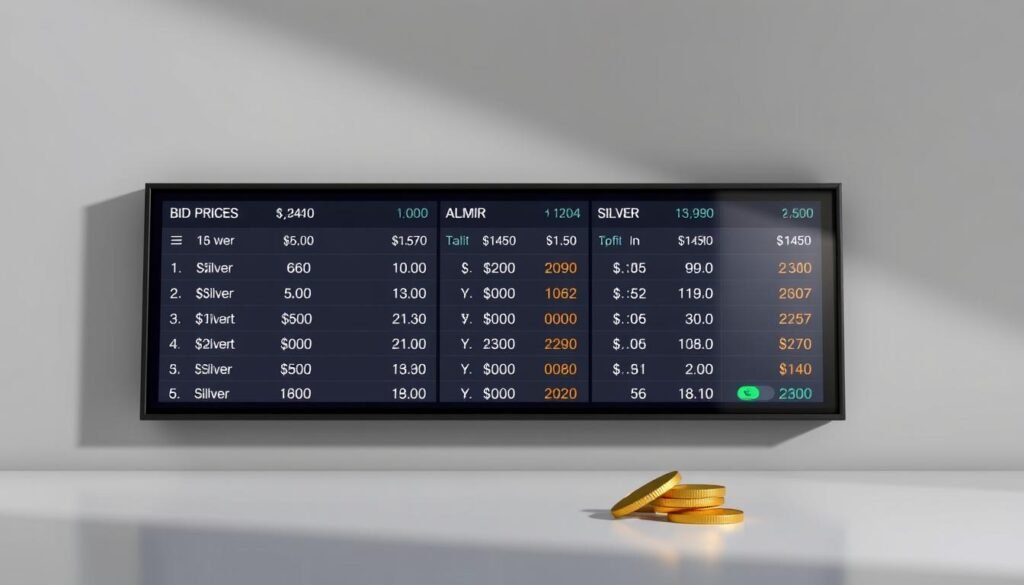
Comparing live boards, bid depth, and market liquidity
Compare published sell prices and the visible bid across at least three dealers. A solid buyback bid reduces your round-trip cost and sometimes beats a slightly lower ask in overall value.
“Validate depth — a published bid that vanishes on execution is not true liquidity.”
Volume tiers and allocation: split to optimize average ask price
Many dealers offer volume tiers that cut per-ounce premiums by 10%–20% for larger purchases. Consolidate orders into standard ounce units to capture those tiers without forcing uncommon product shapes.
| Action | Why it helps | Expected result |
|---|---|---|
| Use dealers with live boards | Shows real-time pricing and depth | Better execution and lower surprise costs |
| Compare bid price across desks | Find stronger buyback bids | Narrower round-trip cost |
| Split large orders | Access volume tiers and inventory | Lower average ask and smoother fills |
- Use limit orders when supported to avoid paying through the spread during fast trading.
- Allocate across multiple dealers if inventory is thin to lower average ask price.
- Include shipping, custodian fees, and insurance in total costs when comparing quotes.
Keep records of quotes and filled orders. That history helps you benchmark dealer performance and refine future execution. In volatile sessions, patience pays: monitor live boards during the overlap window and act when the market narrows to your target.
Decision framework: choosing coins or bars for your Gold IRA objective
Your strategy should match your goals. If you want steady ounce accumulation, prioritize low acquisition cost. If you expect to trade often, prioritize products with broad demand and fast buyback bids.
When to prioritize lowest premium per ounce
Choose bars when cost per ounce matters most. One-ounce bars commonly trade around $25–$45 over spot online, so they cut acquisition drag and improve long-term value.
Bars perform best for long-horizon investors who add regularly and want low fees and compact storage.
When to prioritize resale flexibility and demand depth
Choose coins when you need market recognition and quick execution. American Eagles and Maple Leafs often carry higher prices ($60–$85 and $40–$65 respectively) but attract strong dealer bids.
Coins help active traders and those who may rebalance often, since demand depth can narrow the effective spread at sale.
- Blend a core of bars with a small satellite of leading coins for both low cost and resale agility.
- Model each product’s pricing and dealer bids; a higher ask can be offset by a stronger bid later.
- Stick with standard one-ounce units for the best mix of market access and resale convenience.
Revisit this framework quarterly as markets and demand shift to keep your investment aligned with expected value.
Conclusion
, Use transparent dealer quotes and scheduled execution windows to keep transaction cost from eroding profit.
Stick to a simple playbook. Track live bids, set acceptable markups, and time orders during the London–New York overlap to capture narrower spreads and better pricing.
Blend one-ounce bars for low acquisition cost with a small allocation of leading coins for resale flexibility. Compare dealers, include commissions and storage in your math, and predefine target price points before you buy gold.
With clear rules, repeated review, and patient execution, investors can limit cost drag, protect upside in volatile gold trading, and make smarter decisions for this asset and their markets.