

Surprising fact: as of April 7, 2025 the spot price hovered near $3,000 per ounce, yet investors can own exposure through stored bullion or simple fund shares that trade for $30–$286.
This choice shapes how you hold value, pay costs, and access cash. A self-directed retirement account that holds bullion means you own physical metal stored at an IRS-approved depository and overseen by a custodian. That bullion must meet 99.5% fineness and brings setup, storage, and custodian fees.
By contrast, a gold fund in a brokerage offers fund shares with lower ongoing expense ratios (roughly 0.09%–0.60%) and intraday liquidity. Outside a tax-deferred account many such funds are treated like collectibles for long-term gains up to 28%.
We’ll compare ownership and custody, fees, tax treatment, liquidity, and rules so you can match an option to your retirement goals. If you want a step on how to buy physical metal in a self-directed account, see guidance to buy physical gold in an IRA.
Key Takeaways
- Direct ownership of bullion means storage and custodian oversight; fund shares do not require storage.
- Costs differ: bullion adds setup and storage fees; ETFs tend to have lower expense ratios.
- Liquidity: fund shares trade intraday; selling IRA bullion requires dealer and custodian coordination.
- Tax context: inside tax-deferred accounts you get similar tax treatment; outside, many funds face collectibles rates.
- Due diligence: self-directed accounts are buyer-beware—custodians don’t vet investments.
Why compare physical gold and gold ETFs for your retirement right now
A tight macro backdrop in 2025—with spot prices pushing near record highs and inflation around 3%—makes weighing stored metal against traded funds timely for retirement planning.
Both physical gold and gold etfs give exposure to precious metals, but they differ in ownership, cost, and how fast you can act when markets move.
Physical metal means custody, depository rules, and storage costs. Fund shares offer intraday trades, lower ongoing fees, and simpler IRA handling.
History shows gold can outpace inflation in some decades, though it does not always do so year-to-year. Use a modest allocation to seek a potential hedge and reduce portfolio volatility, not to guarantee gains.
Behavioral and operational differences matter. Some investors like tangible assets they can ultimately hold. Others prefer liquid, low-friction exposure through a brokered etf inside an ira.
| Feature | Physical Metal | Fund Shares |
|---|---|---|
| Ownership | Direct bullion held at an approved depository | Shares that track spot via a fund |
| Liquidity | Slower — dealer and custodian coordination | Fast — intraday trading on exchanges |
| Costs & Taxes | Storage, setup, and custodian fees; IRA rules apply | Expense ratios, tracking costs, and possible tax differences outside retirement accounts |
| Use case | Long-term holders who accept custody tasks | Investors seeking low-friction exposure and trading flexibility |
Consider how many years you plan to hold, your tolerance for storage tasks, and the value of intraday trading. Understanding structure, fees, and custody rules helps avoid surprises inside an ira and supports long-term retirement goals.
What you’re actually buying: Gold IRA, physical bullion, and gold ETFs explained
Before you pick a path, be clear about the ownership you want. One route gives you stored bullion under a custodian; the other gives tradable fund shares that reflect the market price.
How self-directed accounts work with precious metals
A gold ira is a self-directed account that lets you hold approved precious metals. The custodian handles administration, and an IRS-approved depository handles secure storage.
Physical bullion: coins, bars, purity, and storage
Physical gold in an IRA must meet 99.5% fineness for many eligible bars and coins. Home storage is prohibited; the depository stores and reports holdings.
Operationally, you buy through a metals dealer, the custodian records the purchase, and the depository receives and safeguards the metal.
Gold ETFs: structure, holdings, and how shares track price
Gold etfs issue shares that represent fractional interests in a bullion pool or derivative positions. Major funds have expense ratios near 0.09%–0.60% and trade intraday like stocks.
You own fund shares, not the bars, and some funds use derivatives or mining exposure that can alter tracking. Always read the prospectus to verify holdings, structure, and costs.
- Contrast: bullion gives tangible assets you can distribute in-kind; ETFs give liquid shares that settle via brokerage.
- Process: a self-directed setup needs coordination among dealer, custodian, and depository — simpler than investing physical gold directly but more complex than a fund order.
Ownership and custody: tangible metal vs. fund shares
Custody matters more than many investors expect. Deciding how to hold your exposure starts with two different custody models: stored bullion under a custodian, or tradable fund shares in a brokerage account.
Direct asset ownership and IRS-approved depositories
Owning physical gold in a gold ira means you hold a direct interest in specific bars or coins. A custodian coordinates purchases and delivers the metal to an IRS-approved depository.
Chain of custody shows up on statements: depository inventory lists serial numbers, and the custodian issues periodic account reports. You may elect an in-kind distribution when eligible, but metals cannot be kept at home while in the account.
ETF share ownership and brokerage handling
When you buy a gold etf or related fund, you own shares, not specific bars. Those shares sit in a brokerage account and generally cannot be redeemed for bullion.
Convenience is a key difference: etf shares trade during market hours like stocks, so investors can adjust exposure quickly. Documentation differs too — funds provide a prospectus and brokerage statements, while bullion relies on depository records and custodian files.
Think about access needs and peace of mind: some prefer tangible, insured metals; others favor the speed and simplicity of shares for their long-term investment plan.
Costs and fees compared: storage, custodians, expense ratios, and trading costs
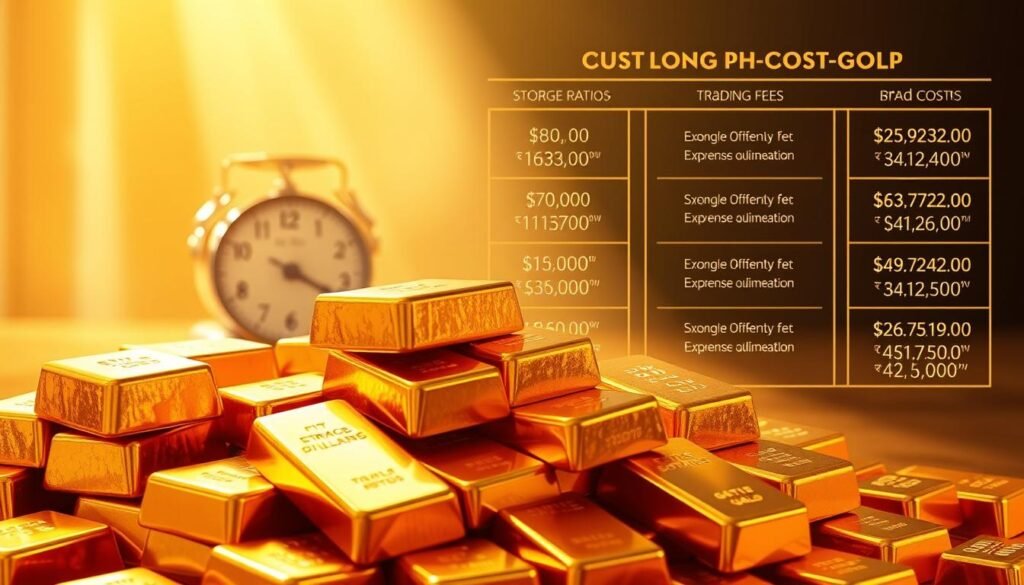
Your effective entry price can jump fast once dealer markups and custodian charges are added. Costs come in many forms: one-time premiums, recurring custody bills, and ongoing management fees for traded funds. Compare them before committing to a retirement allocation.
Gold IRA costs: setup, custodian administration, and depository storage
Account setup and custodian administration typically run $75–$250 per year for precious metals accounts. Some providers add one-time setup or transaction fees on purchases and sales.
Dealer markups and shipping raise the effective price: with spot near $3,000/oz on April 7, 2025, product markups often span roughly 7% to as high as 150% for certain collectible coins. Shipping and insurance add variable charges.
Storage at an IRS-approved depository commonly costs several hundred dollars annually depending on holdings and service level.
ETF costs: management expense ratios, bid-ask spreads, and brokerage fees
Major funds charge management fees (expense ratios) around 0.09%–0.60%. Many brokerages offer $0 online commissions, and large funds usually trade with tight bid-ask spreads.
ETF share prices in 2025 range roughly $30–$286 for common funds. While small, expense ratios compound over time and subtly reduce long-run returns.
Real-world ranges in 2025: what investors typically pay
- Spot price (4/7/2025): about $3,000 per ounce.
- Physical purchase markups: ~7%–150% depending on product.
- Custodian maintenance: $75–$250 per year typical.
- Storage: several hundred dollars annually at depositories.
- ETF fees: 0.09%–0.60% expense ratios; tight spreads; many $0 commissions.
Small-budget investors often find traded funds more cost-effective because there are no storage charges and lower minimums. Larger allocations can justify bullion despite storage and setup costs if lower markups are negotiated.
Bottom line: calculate annualized all-in fees over your expected holding period to compare investing physical gold in a self-directed account versus funds. For more on downsides you should weigh, see this detailed analysis.
Taxes and RMDs: how the IRS treats a Gold IRA vs gold ETFs
How the IRS treats holdings can shift the net return for savers holding bullion or fund shares.
Traditional or Roth options: A gold ira may be held as a traditional or Roth account. Traditional contributions can be deductible, growth is tax-deferred, and distributions are taxed as ordinary income. Roths offer qualified tax-free withdrawals after meeting age and holding rules.
Collectibles and taxable accounts: Many gold etfs held in taxable accounts are treated like collectibles for long-term gains, which can face rates up to 28%. ETF structure varies, so check the prospectus and consult a tax pro for reporting specifics.
RMDs and bullion distributions: Required minimum distributions apply to traditional iras (ages vary by birth year). For bullion, you can sell metal to raise cash for the RMD or take an in-kind distribution of coins or bars from the depository. Missing an RMD can trigger steep penalties, so coordinate with your custodian early each year.
Plan ahead: Keep careful records and get professional advice when dealing with collectibles rules, in-kind transfers, or complex tax reporting for retirement investments.
Liquidity and trading: timing your moves in volatile markets
When markets swing quickly, how fast you can exit a position matters more than headline returns. Liquidity differences shape whether you capture brief price moves or miss them while paperwork clears.
Selling physical gold held inside a gold ira requires steps: request liquidation with your custodian, instruct the depository to release the bars or coins, and coordinate with a dealer or buyback program. Processing, shipping, and handling commonly add days to settlement.
That operational lag makes timing short-lived spikes harder. Investors who want quick access often find the delay costly when a rapid price move reverses within hours.
ETF orders and intraday access
By contrast, a gold etf trades intraday through a brokerage like widely held stocks. You can use market, limit, or stop orders to control execution and placement.
Shares usually have tight bid-ask spreads for large funds, which helps efficient entry and exit during fast moves. Settlement is typically T+2, so cash availability timing still matters if you plan to redeploy proceeds.
- Plan: use limit orders on etfs to lock a target price during volatility.
- Prepare: pre-establish bullion liquidation steps with custodians and dealers.
- Stress test: in stressed markets, spreads widen for both traded funds and physical buybacks, so plan for slippage.
Bottom line: if intraday flexibility matters, etfs offer faster execution. If you value tangible holdings, accept slower transactions and keep buyback contacts current to reduce delay.
Returns and tracking: why ETF performance can diverge from spot gold
Small frictions add up. Tiny management fees, the fund’s portfolio choices, and use of derivatives can make a gold etf track the spot price imperfectly over time.
Fund structure matters: expense ratios and holdings influence long-term tracking. Some funds hold futures or related securities that change return patterns versus holding physical bullion.
Data highlight the effect. As of April 7, 2025, GLD lagged physical gold over multiple horizons — about 27.22% vs 33.44% for one year, and 75.41% vs 97.60% over five years. Fees and structure help explain that gap.
The hidden costs of physical ownership
Owning physical gold faces upfront markups, bid-ask spreads, and recurring storage charges. Those carry costs are not shown in spot-price charts but lower realized value when you sell.
- ETF benefits include easy trading, reinvestment options, and low operational hassle.
- ETF drawbacks: expense drag and potential derivative exposure that can cause tracking error.
- Physical drawbacks: dealer markups and storage reduce net returns despite matching physical spot.
Time amplifies differences. Over years, small annual costs compound and can materially affect investments. Choose low-fee funds and high-liquidity products to minimize tracking drag, or negotiate competitive markups and storage for physical holdings.
Bottom line: look past headline spot moves. Compare all-in costs and expected holding time to choose the vehicle that best fits your performance goals.
Rules, limits, and mechanics inside retirement accounts
Retirement rules set the guardrails for how you add metals and manage distributions inside a tax-advantaged account.
Contribution caps and tax treatment
Annual limits: For 2024–2025 the total IRA contribution cap is $7,000. If you are 50 or older, the catch-up adds $1,000 for an $8,000 maximum. These limits apply equally to a gold ira.
Traditional vs. Roth: Traditional iras let you make tax-deductible contributions and defer tax on growth until withdrawal. Roth accounts use after-tax money and can deliver tax-free qualified withdrawals in retirement. Choose based on current brackets and expected future tax rates.
Eligible metals and fineness standards
Acceptable bullion: Metals must meet IRS standards to stay compliant. Gold held inside an IRA generally requires 99.5% fineness. Similar purity rules apply to certain silver and platinum products.
Storage: Approved metals must be held at an IRS-approved depository. Home storage disqualifies the asset and risks tax penalties and loss of account status.

Operational steps and paperwork
To open an account, pick a custodian to establish the IRA, a dealer or broker to execute purchases, and an IRS-approved depository to store assets. Custodians handle administration but do not vet investments—sdiras are buyer-beware.
Rollovers and transfers require care. A trustee-to-trustee transfer avoids withholding and tax events when moving funds into a gold ira. Timing matters; follow custodian procedures to avoid missed deadlines and taxable distributions.
- Confirm all fees, storage terms, and buyback procedures in writing before you buy.
- Custodians file 5498 and 1099-R forms; depositories provide inventory confirmations for your assets.
- ETFs can also live inside IRAs, preserving retirement tax rules while offering liquid exposure to gold via fund shares.
Bottom line: follow IRS purity and storage rules, respect contribution limits, and do due diligence on providers so your retirement account keeps its tax advantages.
Risks and pitfalls to watch: security, regulation, and market behavior
Risk in precious metals retirement accounts often hides in paperwork, providers, and timing—not just price moves.
SDIRA “buyer‑beware.” Custodians generally handle paperwork but do not evaluate investment quality. That leaves vetting dealers, storage facilities, and product authenticity to the investor.
Multiple parties — dealer, custodian, and depository — add steps, fees, and operational risk. Confirm written buyback and liquidation procedures before you buy.
Operational, security, and regulatory warnings
Storing metal brings theft and insurance concerns. Use reputable, insured, IRS‑approved depositories and check audit reports and coverage limits.
Many SDIRA custodians are not registered investment advisers and face lighter oversight than major brokerages. That regulatory gap raises the need for careful due diligence.
Market behavior: volatility and the inflation‑hedge myth
Precious metals can be volatile and may underperform stocks for long stretches. For example, over long periods the S&P 500 outpaced bullion in many decades.
ETF and fund risks: Funds face tracking error, tax complexity, and management risk. Review structure and tax reporting carefully and consider liquidity stresses: spreads widen in turmoil for both traded shares and dealer buybacks.
| Risk area | What to check | Practical step |
|---|---|---|
| Custodial limits | Services performed, annual fees, audit frequency | Request fee schedule and recent audit reports |
| Storage & security | Insurance coverage, segregation, access rules | Confirm insured limits and segregation policy in writing |
| Market & liquidity | Spread behavior, buyback procedures, settlement timing | Test small transactions and confirm dealer buyback terms |
| Fund structure & taxes | Physical holdings vs derivatives, tax treatment in taxable accounts | Read prospectus and get tax advice |
Bottom line: align any allocation with your risk tolerance and the rest of your portfolio. Diversify, verify providers, and use trusted sources like a comparison of physical bullion versus exchange-traded funds when choosing vehicles for long-term investments.
Gold IRA vs EFT: which option fits your goals, time horizon, and risk tolerance
Your time horizon and need for access matter most. Decide whether you want tangible holdings you can distribute in kind at retirement or liquid fund shares that trade like stocks. Match the choice to your portfolio plan and expected holding time.
Profiles that favor tangible metals and long-term diversification
Who: investors who value direct ownership of physical gold and accept depository storage.
Why: in-kind distributions, clear linkage to bullion, and a disciplined buy-and-hold approach appeal to patient holders.
Trade-offs: higher ongoing costs, more paperwork, and slower liquidity than traded funds.
Profiles that benefit from ETF liquidity, lower minimums, and ease of use
Who: investors wanting low-friction access and the ability to rebalance quickly inside a brokerage account.
Why: intraday liquidity, lower minimums, and easier portfolio integration reduce operational burden.
Trade-offs: management fees, potential tax differences in taxable accounts, and no redemption for bullion.
| Feature | Physical holdings | Traded fund shares |
|---|---|---|
| Best for | Patient investors seeking tangible assets | Active rebalancers and low-minimum investors |
| Liquidity | Slow — custodian and dealer steps | Fast — intraday trading |
| Costs & taxes | Storage, custodian fees, potential in-kind benefits | Expense ratios, possible collectibles tax in taxable accounts |
Tip: many investors use a core of fund shares plus a smaller physical position. For more context see a detailed physical gold and ETFs comparison. Plan allocation size, rebalancing rules, and review intervals in writing to keep decisions consistent.
Conclusion
Weigh storage duties against trading ease when you add precious metals to a retirement plan.
Physical gold via a gold ira gives direct, tangible exposure but brings setup, custody, and storage costs to manage. Fund shares and ETFs offer low minimums and fast trading, yet they do not give possession of metal and can show different tax treatment outside tax-deferred accounts.
Neither choice is universally better. Match selection to your holding horizon, liquidity needs, and willingness to handle paperwork. Run a total-cost calculation—markups, storage, expense ratios, and spreads—over your planned holding period.
Do due diligence on custodians or funds, align any allocation with your portfolio and cash‑flow plan, and consult a qualified financial or tax professional for personalized guidance.