

Planning for retirement involves navigating various investment vehicles and understanding how they interact with your Social Security benefits. Gold IRAs have gained popularity as a hedge against inflation and economic uncertainty, but many investors wonder: do gold IRA affect social security benefits? This comprehensive guide explores this important relationship, helping you make informed decisions about incorporating precious metals into your retirement strategy while maximizing your government benefits.
Understanding Gold IRAs: Purpose and Function
A Gold IRA is a self-directed Individual Retirement Account that allows you to invest in physical precious metals like gold, silver, platinum, and palladium. Unlike traditional IRAs that typically hold paper assets such as stocks, bonds, and mutual funds, Gold IRAs provide a way to diversify your retirement portfolio with tangible assets.
Gold IRAs function similarly to traditional IRAs in terms of contribution limits, required minimum distributions (RMDs), and general tax treatment. However, they require a specialized custodian who handles the purchase, storage, and insurance of the physical metals in IRS-approved depositories.
The primary purpose of a Gold IRA in retirement planning is to:
- Provide a hedge against inflation and currency devaluation
- Diversify retirement holdings beyond traditional paper assets
- Offer potential protection during economic downturns
- Create a tangible asset class within tax-advantaged retirement accounts
Like traditional IRAs, Gold IRAs come in both traditional (tax-deferred) and Roth (tax-free growth) varieties, each with different implications for your retirement income and Social Security benefits.
Do Gold IRA Investments Impact Social Security Eligibility?
The good news is that simply owning a Gold IRA does not affect your eligibility for Social Security benefits. The Social Security Administration does not consider your assets or net worth when determining your eligibility or benefit amount. Whether you have $10,000 or $10 million in retirement accounts, including Gold IRAs, your basic Social Security benefit calculation remains unchanged.
However, there’s an important distinction to understand regarding distributions from your Gold IRA:
Gold IRA and the Earnings Test
Distributions from your Gold IRA are not considered “earned income” for the Social Security earnings test. This means that even if you withdraw substantial amounts from your Gold IRA before reaching full retirement age, these withdrawals will not trigger benefit reductions under the earnings test.
Only income from active work (employment or self-employment) counts toward the earnings test threshold. This provides flexibility for early retirees who want to supplement their income with Gold IRA distributions while collecting Social Security.
Gold IRA and Benefit Calculations
The Social Security Administration calculates your benefit amount based on your 35 highest-earning years of work. Gold IRA investments, regardless of their performance, do not factor into this calculation.
Your benefit amount is determined by your work history and the age at which you claim benefits, not by your retirement account balances or investment choices. This means your decision to invest in a Gold IRA will neither increase nor decrease your base Social Security benefit.
Gold IRA Distributions and Social Security Taxation

While Gold IRAs don’t affect Social Security eligibility, distributions from traditional Gold IRAs can significantly impact how your Social Security benefits are taxed. This is where careful planning becomes essential.
Traditional Gold IRA Distributions
Distributions from a traditional Gold IRA are generally taxable as ordinary income in the year you receive them. These distributions increase your adjusted gross income (AGI), which is a key component of the “combined income” formula used to determine if your Social Security benefits are taxable.
Example: John has $20,000 in Social Security benefits and $15,000 in other income. His combined income is $15,000 + $0 + ($20,000 ÷ 2) = $25,000, right at the threshold. If he takes a $10,000 distribution from his traditional Gold IRA, his combined income increases to $35,000, making up to 85% of his Social Security benefits taxable.
Roth Gold IRA Distributions
Qualified distributions from a Roth Gold IRA are tax-free and do not increase your AGI or combined income. This means they won’t trigger taxation of your Social Security benefits, making Roth accounts particularly valuable for retirement income planning.
“Roth Gold IRAs offer a significant advantage for Social Security recipients. Since qualified distributions aren’t included in the combined income calculation, they allow you to access retirement funds without increasing the taxation of your Social Security benefits.”
Traditional IRAs vs. Gold IRAs: Social Security Considerations
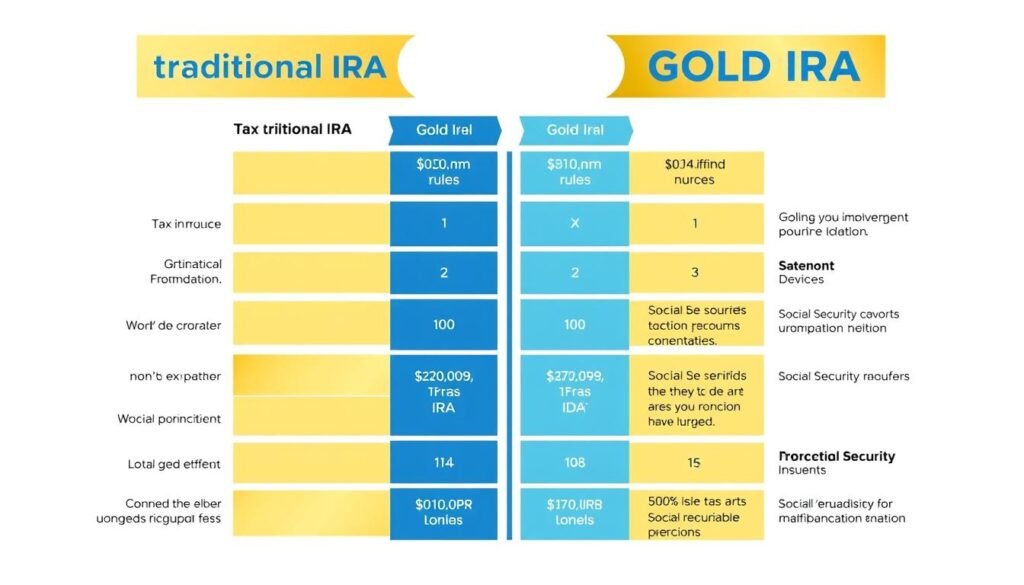
When comparing traditional IRAs and Gold IRAs in relation to Social Security benefits, the underlying tax treatment is more important than the investment assets themselves. The key distinction is between traditional (pre-tax) and Roth (after-tax) accounts, not necessarily between paper assets and precious metals.
| Aspect | Traditional IRA (Paper Assets) | Traditional Gold IRA | Roth IRA (Paper Assets) | Roth Gold IRA |
| Impact on Social Security Eligibility | None | None | None | None |
| Distributions Count as Earned Income | No | No | No | No |
| Distributions Increase AGI | Yes | Yes | No | No |
| Can Trigger Social Security Taxation | Yes | Yes | No | No |
| Required Minimum Distributions | Yes, starting at 73 | Yes, starting at 73 | No (for original owner) | No (for original owner) |
The primary advantage of Gold IRAs is not preferential treatment regarding Social Security, but rather portfolio diversification and potential protection against economic factors that could affect both paper assets and the purchasing power of Social Security benefits.
Practical Considerations for Retirees with Gold IRAs

If you’re approaching retirement with a Gold IRA, consider these practical strategies to optimize your Social Security benefits:
Required Minimum Distributions (RMDs)
Traditional Gold IRAs are subject to RMDs beginning at age 73. These mandatory withdrawals will increase your taxable income and potentially trigger Social Security benefit taxation. Plan for this tax impact in advance, especially if you have substantial traditional IRA balances.
Distribution Timing
Consider the timing of your Gold IRA distributions in relation to your Social Security claiming strategy. If possible, take larger distributions before claiming Social Security or in years when your other income is lower to minimize the combined income calculation.
Asset Liquidation Planning
Gold IRAs require converting physical precious metals back to cash before distribution. This process can take time and may be subject to market fluctuations. Plan your distributions well in advance, especially for RMDs, to avoid penalties and unfavorable selling conditions.
State Tax Considerations
While this guide focuses on federal taxation of Social Security benefits, remember that state tax rules vary. Some states exempt Social Security benefits from taxation, while others follow federal rules or have their own formulas. Consider state tax implications when planning Gold IRA distributions.
Tax Strategies: Minimizing Impact on Social Security

Several strategies can help minimize the tax impact of Gold IRA distributions on your Social Security benefits:
Tax Minimization Strategies
- Roth Conversions: Consider converting portions of your traditional Gold IRA to a Roth Gold IRA during lower-income years before claiming Social Security.
- Qualified Charitable Distributions (QCDs): Once you reach age 70½, you can donate up to $100,000 annually from your traditional IRA directly to charity, satisfying RMD requirements without increasing AGI.
- Strategic Withdrawal Sequencing: Coordinate withdrawals from different account types (taxable, tax-deferred, and tax-free) to manage your annual taxable income.
- Income Smoothing: Plan distributions to maintain relatively consistent income levels year to year, avoiding spikes that could push you into higher tax brackets.
- Delay Social Security: Consider using Gold IRA distributions to fund early retirement while delaying Social Security benefits until age 70, increasing your lifetime benefit amount.
Approaches to Avoid
- Large Lump-Sum Withdrawals: Taking large distributions in a single year can dramatically increase your combined income and Social Security taxation.
- Ignoring RMDs: Failing to take required distributions results in a 25% penalty on the amount not withdrawn.
- Overlooking State Taxes: Not considering state-specific tax rules can lead to unexpected tax liabilities.
- Disregarding Medicare Premiums: Higher income from Gold IRA distributions can increase your Medicare Part B and D premiums through IRMAA surcharges.
- Reactive Planning: Waiting until distribution time to consider tax implications limits your options for tax management.
Get Expert Guidance on Gold IRAs and Retirement Planning
Balancing Gold IRA investments with Social Security benefits requires careful planning. Our specialists can help you develop a tax-efficient strategy tailored to your retirement goals.
Common Misconceptions About Gold IRAs and Social Security
Misconception: Gold IRAs are exempt from RMDs
Reality: Traditional Gold IRAs are subject to the same RMD rules as any traditional IRA. Only Roth IRAs (including Roth Gold IRAs) are exempt from RMDs for the original owner.
Misconception: Gold IRA distributions don’t count toward income
Reality: Distributions from traditional Gold IRAs are taxable as ordinary income and do count toward your adjusted gross income, potentially affecting Social Security taxation.
Misconception: Gold IRAs provide special tax advantages with Social Security
Reality: Gold IRAs follow the same tax rules as traditional or Roth IRAs invested in other assets. The tax treatment depends on the account type (traditional vs. Roth), not the underlying investment.
Misconception: Gold IRA withdrawals count as earned income for the earnings test
Reality: IRA distributions, including from Gold IRAs, are not considered earned income for the Social Security earnings test. Only income from active work counts toward this limit.
Misconception: Converting to a Gold IRA eliminates taxes on Social Security
Reality: Simply converting to a Gold IRA doesn’t change the tax treatment. Converting from a traditional to a Roth Gold IRA can help reduce future Social Security taxation, but the conversion itself is a taxable event.
Expert Recommendations for Balancing Gold IRAs with Social Security

Financial experts recommend these approaches for effectively integrating Gold IRAs into your retirement and Social Security strategy:
Diversification Strategy
Allocate only a portion (typically 5-15%) of your overall retirement portfolio to precious metals. This provides diversification benefits while leaving sufficient assets in more liquid investments to manage income needs and tax planning.
Account Type Balance
Maintain a mix of traditional and Roth accounts, including Gold IRAs. This gives you flexibility to draw from different tax buckets in retirement, helping manage your taxable income and Social Security taxation.
Long-Term Perspective
View Gold IRAs as a long-term holding strategy rather than a source of frequent distributions. This aligns with gold’s historical role as a store of value and can help minimize transaction costs associated with liquidating precious metals.
“The ideal approach combines traditional tax-deferred accounts, Roth accounts, and taxable investments with a strategic withdrawal plan that minimizes the taxation of Social Security benefits while providing income security throughout retirement.”
Working with financial advisors who understand both precious metals investing and retirement income planning can help you develop a comprehensive strategy that optimizes your Gold IRA investments while maximizing your Social Security benefits.
Conclusion: Making Informed Decisions

Gold IRAs can be a valuable component of a diversified retirement strategy, but understanding their relationship with Social Security benefits is essential for effective planning. While Gold IRAs don’t affect your Social Security eligibility or benefit amount, distributions from traditional Gold IRAs can impact how your benefits are taxed.
By understanding the tax implications, planning distribution strategies carefully, and potentially utilizing Roth accounts, you can incorporate precious metals into your retirement portfolio while minimizing adverse effects on your Social Security benefits. The key is taking a holistic approach to retirement planning that considers all income sources and their tax treatment.
Remember that retirement planning is highly individual, and what works for one person may not be optimal for another. Consider consulting with financial professionals who specialize in retirement income planning to develop a strategy tailored to your specific circumstances and goals.
Ready to Optimize Your Retirement Strategy?
Our Gold IRA specialists can help you understand how precious metals can complement your Social Security benefits and other retirement income sources.
Social Security Benefits: How They Work
Social Security provides a foundation of retirement income for millions of Americans. Benefits are calculated based on your lifetime earnings, with higher earners generally receiving larger monthly payments. The age at which you begin collecting benefits also impacts your payment amount—starting before your full retirement age reduces your benefit, while delaying until age 70 increases it.
Two key aspects of Social Security that interact with retirement accounts like Gold IRAs are:
The Earnings Test
If you claim Social Security benefits before reaching your full retirement age (currently between 66-67 for most people), your benefits may be temporarily reduced if your earned income exceeds certain thresholds. In 2025, beneficiaries can earn up to $23,400 without penalty if they’ll reach full retirement age after 2025.
Taxation of Benefits
Your Social Security benefits may become partially taxable when your “combined income” exceeds certain thresholds. Combined income is calculated as:
Combined Income = Adjusted Gross Income + Nontaxable Interest + ½ of Social Security Benefits
For individuals with combined income between $25,000 and $34,000 (or couples filing jointly with combined income between $32,000 and $44,000), up to 50% of benefits may be taxable. Above these upper thresholds, up to 85% of benefits may be taxable.