
Tag: Safe haven assets

  • Gold vs. The S&P 500: Which Asset is Protecting Wealth in 2026?

    Gold vs. The S&P 500: Which Asset is Protecting Wealth in 2026?

    Picture this: a small group of friends met after a long year of market noise and stories of big gains. One held a bar of precious metal, another an index fund statement, and both were surprised to find they felt equally nervous about the next storm.

    Late 2025 left both assets near record highs. That moment forced a simple question for U.S. investors: which asset will better protect purchasing power and limit severe drawdowns as we head into a new year?

    In this piece we define “wealth protection” as resilience against big losses, a hedge for inflation and currency shocks, and preserving optionality during volatile markets. You’ll get a clear comparison: a hard-asset hedge with no yield but safe-haven demand, and the S&P 500 as a growth engine sensitive to valuations and earnings.

    We preview the decision framework: macro drivers (rates, inflation, dollar), structural demand (central banks, ETF flows), and equity fundamentals (earnings, AI expectations). Expect practical advice on access (ETFs, index funds, futures), risks to respect, and how time horizon changes the better fit.

    For more on practical retirement-safe options and straightforward comparisons, see this guide on retirement resources at retirement investing resources.

    Key Takeaways

    • Wealth protection means limiting drawdowns and preserving purchasing power, not just chasing gains.
    • Compare macro drivers, structural demand, and equity fundamentals when allocating between assets.
    • Hard assets can hedge shocks; the S&P 500 offers earnings-driven growth but is valuation-sensitive.
    • Access options matter: ETFs, index funds, and futures carry different costs and risks.
    • Your time horizon and risk tolerance will determine which asset fits your portfolio best.

    What 2025 Revealed About Wealth Protection in Gold and Stocks

    Last year’s charts told two parallel stories: one of rising safe-haven demand and one of stretched equity optimism. Spot metals climbed to a record near $4,560/oz before slipping to about $4,400 after a >4% pullback tied to margin hikes and profit-taking.

    That rally signaled uncertainty: geopolitics, tariff worries, inflation anxiety and slower confidence all drove persistent demand. Gold ETFs added assets for six straight months, pushing global ETF holdings past ~$0.5T and showing allocation shifts matter for price moves.

    The dollar fell roughly 10% against major currencies in 2025, and Fed rate cuts made non-yielding metal more attractive versus yielding alternatives. Still, the pullback shows risk: margins and trader behavior can cause sharp drops even in bull phases.

    The S&P 500 ended the year near record levels, led by heavy AI spending narratives. Strong gains coexisted with rising valuation questions. Remember: protecting wealth is not the same as maximizing returns—an all-growth portfolio can shine in calm rallies but fail when markets stress.

    1. 2025 was a stress test: assets that respond to fear diverge from those that respond to growth.
    2. Diversification matters: allocation, not headlines, often determines protection during shocks.

    Gold vs Stocks 2026: Drivers That Could Decide the Winner

    Several clear drivers — from rate moves to central-bank buying — will set the tone for returns and protection.

    Interest rates and Fed policy

    Why rate cuts can favor a non-yielding asset

    When interest rates fall, the “opportunity cost” of holding a non-yielding asset shrinks. That makes it easier for investors to prefer a store of value over low-yield cash or some bonds.

    Fed easing in late 2025 already boosted appeal. Lower yields often reduce real rates, which can lift demand and help price support.

    A dynamic and visually striking composition featuring gold bars and coins as the foreground, placed prominently on an elegant surface, reflecting a warm glow. In the middle ground, visualize a stock market graph showing fluctuating lines, incorporating a mix of rich gold and deep blue colors to signify the contrasting themes of wealth protection. The background showcases a modern city skyline at twilight, bathed in soft orange and purple hues. This setting conveys a sense of financial aspiration and competition. Use soft lighting to create a warm and inviting atmosphere, while maintaining a professional and polished look. The overall mood should evoke a sense of investment potential and careful consideration in the financial market landscape. Depth of field should focus on the gold in the foreground, softly blurring the cityscape, emphasizing the importance of gold in wealth preservation.

    How inflation and currency moves change allocation

    Persistent inflation or tariff shocks push investors to hedge purchasing power. If real rates fall and the dollar weakens, global buyers may increase allocation.

    Remember: a weaker dollar can mechanically lift dollar-denominated values and reinforce buying momentum abroad.

    Structural demand and flows

    Reserve buying, ETFs, and concentrated demand

    Central banks are a steady force: a WGC survey found 95% expect to add reserves. That creates ongoing structural demand and a price floor.

    Large ETF inflows — including record quarterly inflows in 2025 — concentrate buying into liquid wrappers and can push targets cited by analysts.

    Risk, margin moves, and sudden pullbacks

    Geopolitics, profit-taking, and margin shocks

    During uncertainty, safe-haven bids often compete with an equity risk premium. But margin hikes or profit-taking can cause sharp, short dips even inside an uptrend.

    “CME margin increases in 2025 triggered a quick selloff before prices snapped back,”

    Watch the dashboard: rates, inflation, dollar value, central-bank action, and ETF flows together determine which asset has the edge.

    The S&P 500 Outlook for 2026: Growth Potential, Valuation Risk, and Volatility

    After a strong run, the S&P 500 faces a year where profits must do the heavy lifting for returns. A reasonable planning baseline is about 7% annual return, according to market research, if earnings expansion holds.

    Reasonable return expectations

    Ayako Yoshioka cites an average near 7% for the index. For that to happen, earnings need to grow more than 12% and margins must stay resilient.

    That means steady revenue, controlled costs, and benign macro conditions so profits compound without a valuation reset.

    AI infrastructure and elevated multiples

    AI spending supports the narrative but raises risk. If capex doesn’t translate to durable profits, high multiples can compress quickly.

    “Experts warn volatility as the AI theme is debated.”

    Broader equity opportunities and sector themes

    Small- and mid-cap firms could catch up if rates stabilize and M&A returns. Financials may see net interest margin gains from a steeper yield curve, helping earnings even in slower growth.

    International equities as a diversifier

    Developed international markets offer lower valuations, higher dividends, and possible currency tailwinds. That can reduce reliance on U.S. megacaps and smooth portfolio outcome.

    For a concise read on wider market signals and positioning, consider this note on stock market trends.

    Which Asset Better Protects Wealth in 2026? Use-Cases, Risks, and Portfolio Fit

    Protection depends less on hero assets and more on which macro script actually plays out next year. Choose based on likely scenarios, not wishful thinking.

    When a defensive metal makes sense: slowdown, geopolitical stress, falling real rates, dollar weakness, and steady central bank buying all boost the case for gold. Many analysts set gold 2026 targets in a $4,000–$5,000 range, with some forecasts near $4,900 and upside toward $5,000 if reallocations persist.

    When stocks protect better: steady growth, controlled inflation, and supportive monetary policy let earnings do the heavy lifting. If companies deliver 12%+ profit growth, the S&P 500 can offer sensible returns and rebuild wealth over time.

    A luxurious scene depicting gold as a symbol of wealth protection. In the foreground, a gleaming, intricately designed gold shield prominently displays its luster, reflecting light in multiple angles. Surrounding the shield, scattered gold coins add to the opulence. In the middle ground, focus on a polished wooden desk with a sleek laptop showing upward trending financial graphs, symbolizing the S&P 500. The background features a soft-focus skyline of a modern city, bathed in warm, golden sunset light, enhancing the atmosphere of prosperity and security. The overall mood is confident and hopeful, with a sense of financial stability. The image is captured from a low angle to emphasize the gold shield, with natural light casting dynamic shadows.

    “Significant upside is possible if investors shift equity and bond exposure into metal ETFs.”

    Scenario Best fit Main risks How to access
    Slowdown, weak dollar Gold shelter Rising rates, demand cooling ETFs, futures
    Steady growth, stable inflation S&P 500 and broad equity Valuation shock, AI disappointment Index funds, ETFs
    Mixed/uncertain Blend of both Volatility, liquidity needs Rebalance, set time horizon

    Match allocation to your time horizon and liquidity needs. Keep rebalancing discipline and use products—ETFs, futures, index funds—that fit your risk tolerance. That way you reduce regret and keep upside potential while guarding against sharp drawdowns.

    Conclusion

    Your protection plan hinges on whether growth or shock drives markets in the months ahead.

    Gold vs Stocks 2026 boils down to engines of protection: one rests on hard-asset demand and structural reserve buying, the other on business earnings and durable growth. Both can preserve wealth, but they respond to different forces.

    Watch the hinge factors: interest rates, Fed policy, inflation and tariff spillovers, the dollar, and whether uncertainty stays high or fades. Research and data point to solid structural support for gold and a cautious outlook for the s&p 500 that needs strong earnings to justify current prices.

    Pick an allocation range that matches your time horizon, commit to rebalancing, and act with discipline. Winners depend on scenarios, so build resilience across years and keep your plan ready to adapt.

    FAQ

    How did 2025 change the conversation about protecting wealth with gold compared to equities?

    The surprise rally in precious metals during 2025 highlighted rising uncertainty—central bank buying and ETF demand pushed prices higher, while the S&P 500’s gains raised valuation questions. That year showed protecting capital can mean different things: stability and liquidity versus long-term growth and income from stocks.

    If the Fed cuts rates in 2026, which asset typically benefits more?

    Lower policy rates usually reduce the real yield on cash and bonds, making non-yielding assets more attractive. In that environment, bullion often gains because opportunity cost falls, while equities can also rally—especially rate-sensitive sectors—but they depend on earnings momentum.

    What role do central banks play in supporting bullion prices next year?

    Central banks continue diversifying reserves away from a single currency. Ongoing official purchases provide structural demand and a price floor, particularly if geopolitical uncertainty or distrust of fiat currencies increases.

    Can ETF flows swing market leadership between precious metals and the S&P 500?

    Yes. Large inflows into metal-backed ETFs amplify buying pressure and can accelerate rallies. Conversely, heavy equity inflows, especially into large-cap index funds and AI-related themes, can drive the S&P 500 higher and attract capital away from safe havens.

    What are realistic return expectations for U.S. large-cap stocks in 2026?

    A reasonable, conservative target is roughly mid-single-digit to low double-digit nominal returns. Analysts often cite around 7% as a base case if earnings grow about 10–12% and valuations remain stable, but outcomes depend on inflation and profit execution.

    Which macro scenario gives the biggest upside to bullion?

    A growth slowdown combined with persistent inflation or renewed currency weakness benefits precious metals most. In that case, continued central bank buying and safe-haven flows could push prices toward much higher targets over time.

    What are the main risks for metal investors in 2026?

    The big risks are rising real interest rates, a stronger U.S. dollar, and a drop in demand from ETFs or official buyers. Rapid profit-taking or changes in margin requirements for futures can also create sharp short-term pullbacks.

    What are the main risks for equity investors next year?

    Key threats include valuation compression if earnings disappoint, higher-than-expected inflation that forces tighter policy, and an AI cycle that fails to deliver broad productivity gains. These factors can increase volatility and lower near-term returns.

    How should an investor split allocation between bullion exposure and S&P 500 funds?

    There’s no one-size-fits-all answer. A balanced approach ties allocation to goals and horizon: shorter horizons and capital preservation favor higher metal exposure, while longer horizons and growth objectives favor larger equity weightings. Many advisors suggest a modest allocation to precious metals as portfolio insurance.

    What investment vehicles are easiest for U.S. investors to gain exposure to each asset?

    For metals, the simplest options are bullion ETFs and allocated storage; futures offer leverage but higher complexity. For equities, low-cost S&P 500 index funds and diversified ETFs provide broad exposure with low fees and easy rebalancing.

    How do inflation and tariffs influence asset selection between bullion and stocks?

    Rising inflation and trade friction often favor bullion because it preserves purchasing power and acts as a hedge against currency pressure. Equities can do well if companies pass costs to consumers, but margins and growth can suffer under sustained inflation and higher tariffs.

    Should international equities be part of a diversification plan in 2026?

    Yes. International stocks can offer lower valuations, higher dividend yields, and currency diversification. They can reduce portfolio concentration risk and provide alternative growth drivers if U.S. large caps face valuation headwinds.

    How quickly can allocation flows reverse in these markets?

    Very quickly. Market sentiment, policy surprises, or geopolitical shocks can shift flows in days or weeks. That’s why liquidity, clear investment rules, and disciplined rebalancing matter for long-term investors.

    What signals should investors watch to decide whether to favor metals or equities during 2026?

    Key signals include real interest rates, dollar strength, central bank buying, ETF flow data, corporate earnings trends, and macro growth indicators. Monitoring these helps align allocation with changing risk and return prospects.

    Can small- and mid-cap stocks outperform large caps amid this backdrop?

    Yes. If economic growth stabilizes and funding conditions remain supportive, smaller companies with leverage to domestic recovery and cyclical sectors can catch up, offering diversification and potential alpha relative to mega-cap indices.

  • How to Use Safe Haven Assets for IRA Retirement Diversification: A Strategic Guide

    How to Use Safe Haven Assets for IRA Retirement Diversification: A Strategic Guide

    When market volatility strikes, your retirement savings shouldn’t be left exposed to the full force of economic uncertainty. That’s where strategic IRA diversification with safe haven assets comes into play. These protective investment vehicles can act as financial shock absorbers during turbulent times, preserving your hard-earned retirement funds when traditional investments falter.

    In today’s unpredictable economic landscape, incorporating safe haven assets for IRA retirement diversification isn’t just prudent—it’s essential. This guide will walk you through the strategic implementation of these protective assets, helping you build a more resilient retirement portfolio designed to weather various market conditions.

    What Are Safe Haven Assets?

    Safe haven assets are investments that typically maintain or increase their value during periods of market turbulence and economic uncertainty. Unlike conventional investments that may experience significant volatility during downturns, these assets provide a measure of stability and protection when markets become chaotic.

    These protective investments have historically demonstrated resilience during economic downturns, often moving independently or even inversely to broader market trends. This counter-cyclical behavior makes them valuable components in a diversified retirement strategy.

    Key Characteristics of Safe Haven Assets

    • Tend to retain value during market downturns
    • Often have intrinsic value beyond market pricing
    • Generally less correlated with traditional stock markets
    • Provide portfolio stability during economic uncertainty
    • Act as a hedge against inflation in many cases

    Historical Performance

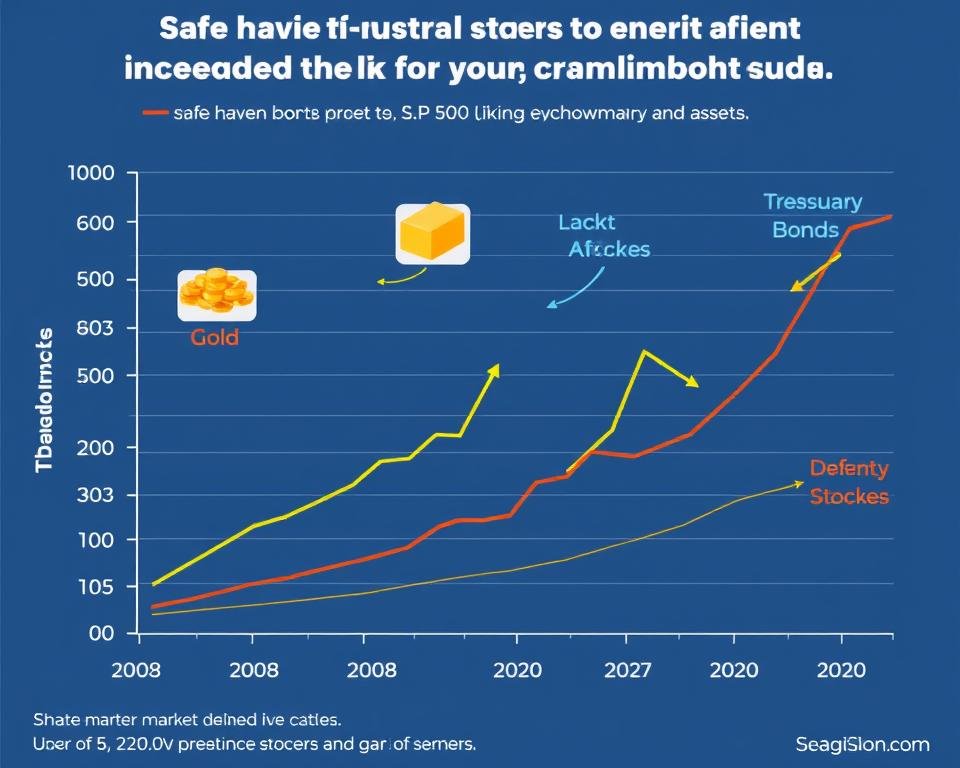
    During the 2008 financial crisis, gold prices surged nearly 25% while the S&P 500 plummeted by over 38%. Similarly, during the COVID-19 market crash of March 2020, U.S. Treasury bonds rallied as investors sought safety, demonstrating how these assets can provide crucial protection when traditional markets falter.

    This historical pattern of performance during crises underscores why safe haven assets for IRA retirement diversification deserve serious consideration in your long-term planning strategy.

    Chart showing performance of safe haven assets during market downturns compared to S&P 500

    Why Include Safe Haven Assets in an IRA?

    Individual Retirement Accounts (IRAs) offer significant tax advantages that make them ideal vehicles for holding safe haven assets. When combined with the stability these assets provide, IRAs create a powerful foundation for long-term retirement security.

    Tax Advantages

    IRAs provide tax-deferred or tax-free growth, allowing your safe haven assets to compound more efficiently over time. Traditional IRAs offer tax-deductible contributions, while Roth IRAs provide tax-free withdrawals in retirement—both enhancing the protective benefits of safe haven assets.

    Inflation Protection

    Many safe haven assets, particularly precious metals and TIPS, have historically served as effective hedges against inflation. This protection is crucial for retirement accounts, where preserving purchasing power over decades is essential to maintaining your standard of living.

    Geopolitical Risk Buffer

    Global tensions, trade disputes, and political instability can wreak havoc on traditional markets. Safe haven assets often strengthen during these periods of uncertainty, providing a buffer against geopolitical risks that might otherwise damage your retirement savings.

    Protect Your Retirement from Market Uncertainty

    Uncertain about how to properly diversify your IRA with safe haven assets? Our retirement specialists can help you create a personalized protection strategy tailored to your risk tolerance and retirement timeline.

    Speak with a Retirement Specialist Today

    Top Safe Haven Assets for IRA Portfolios

    Not all safe haven assets perform equally in different economic scenarios. Understanding the unique characteristics of each can help you build a more resilient IRA portfolio tailored to your specific retirement needs and risk tolerance.

    Gold & Precious Metals

    Gold has been a traditional store of value for thousands of years, often appreciating during periods of market stress, currency devaluation, and geopolitical tension. Within an IRA, investors can gain exposure to gold through specialized ETFs like IAU (iShares Gold Trust) or through a self-directed IRA that allows physical gold holdings.

    Silver and other precious metals also provide similar protective benefits, though typically with more industrial demand influence and potentially higher volatility than gold.

    Advantages

    • Strong historical performance during market crises
    • Effective hedge against currency devaluation
    • No counterparty risk with physical holdings
    • Limited supply enhances long-term value preservation

    Limitations

    • No income generation (dividends or interest)
    • Storage costs for physical holdings
    • Can experience short-term volatility
    • May underperform during strong economic growth

    Gold coins and bars as safe haven assets for IRA retirement diversification

    Treasury Inflation-Protected Securities (TIPS)

    TIPS are government bonds specifically designed to protect against inflation—a significant concern for retirement planning. Unlike standard Treasury bonds, TIPS adjust their principal value based on changes in the Consumer Price Index, ensuring that your investment maintains its purchasing power over time.

    For IRA investors concerned about inflation eroding their retirement savings, TIPS provide a government-backed solution that combines safety with inflation protection.

    4.2
    Overall Protection Rating
    Inflation Protection
    4.5
    Market Crash Protection
    4.0
    Liquidity
    4.3

    Defensive Stocks

    Not all stocks are created equal when it comes to market downturns. Defensive stocks—typically found in sectors like consumer staples, utilities, and healthcare—provide essential products and services that remain in demand regardless of economic conditions.

    Defensive Sector Key Characteristics Example Stocks/ETFs for IRAs Historical Stability
    Consumer Staples Essential household products with consistent demand XLP, PG, KO, PEP High
    Healthcare Medical services and products with inelastic demand XLV, JNJ, PFE, UNH High
    Utilities Essential services with regulated returns XLU, NEE, DUK, SO Very High

    Healthcare and utilities defensive stocks as safe haven assets for IRA retirement diversification

    Real Estate Investment Trusts (REITs)

    Certain types of REITs, particularly those focused on essential properties like healthcare facilities, data centers, and storage units, can provide both stability and income during market turbulence. These specialized REITs often maintain steady cash flows and dividends even when broader markets decline.

    Within an IRA, REITs offer the additional advantage of tax-efficient income, as their typically high dividend yields grow tax-deferred or tax-free depending on your IRA type.

    Medical office building representing healthcare REITs as safe haven assets for IRA retirement diversification

    Cryptocurrency Hedges

    For investors comfortable with higher volatility and emerging asset classes, certain cryptocurrencies like Bitcoin have begun to show some safe haven characteristics, particularly as hedges against currency devaluation and monetary policy concerns.

    Self-directed IRAs now allow for cryptocurrency investments, though these should generally represent a smaller allocation within a diversified safe haven strategy due to their still-evolving market behavior and higher volatility profile.

    “While cryptocurrencies remain controversial as safe havens due to their volatility, Bitcoin’s limited supply and decentralized nature have increasingly attracted investors seeking protection from currency debasement and traditional financial system risks.”

    — Financial Analyst perspective on emerging safe haven assets

    Bitcoin physical coin representing cryptocurrency as an emerging safe haven asset for IRA diversification

    How to Allocate Safe Haven Assets in Your IRA

    Determining the right allocation of safe haven assets for IRA retirement diversification depends largely on your age, risk tolerance, and overall retirement strategy. The following frameworks provide starting points that you can adjust based on your personal circumstances.

    Sample Allocation Frameworks

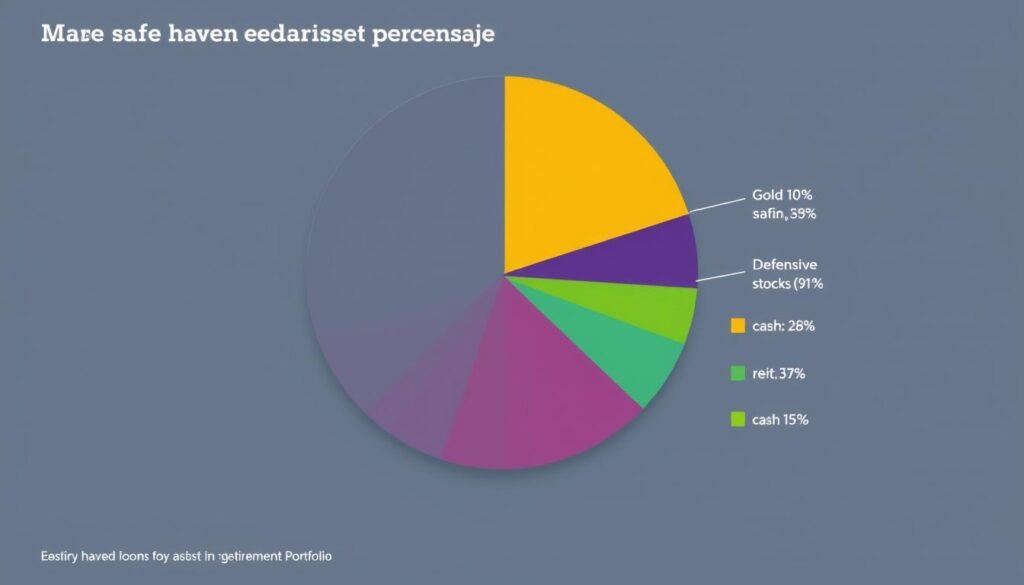
    Risk Profile Gold & Precious Metals TIPS & Treasury Bonds Defensive Stocks REITs Cash/Money Market Crypto (Optional)
    Conservative 10-15% 30-40% 20-25% 5-10% 15-20% 0-2%
    Moderate 5-10% 20-30% 30-40% 10-15% 5-10% 0-5%
    Aggressive 3-8% 10-20% 40-50% 15-20% 2-5% 0-10%

    Pie chart showing safe haven asset allocation for IRA retirement diversification

    Rebalancing Strategies

    Even the best-designed portfolio will drift from its target allocation over time as different assets perform differently. Implementing a disciplined rebalancing strategy helps maintain your desired risk level and ensures your safe haven assets continue to provide the protection you need.

    Calendar Rebalancing

    Set a regular schedule—typically annually or semi-annually—to review your IRA and adjust holdings back to your target allocation. This approach removes emotion from the process and creates a disciplined framework for maintaining your strategy.

    Threshold Rebalancing

    Establish percentage thresholds (e.g., ±5% from targets) that trigger rebalancing when exceeded. This approach is more responsive to market movements but requires more frequent monitoring of your portfolio.

    Get Your Free Safe Haven Asset Guide

    Understanding proper allocation is crucial for effective IRA protection. Download our comprehensive guide to safe haven asset allocation strategies tailored for different retirement timelines and risk profiles.

    Download Free IRA Safe Haven Guide

    Risks and Limitations of Safe Haven Assets

    While safe haven assets provide valuable protection, they come with their own set of limitations and potential drawbacks that investors should carefully consider before implementation.

    Growth Limitations

    The very stability that makes safe haven assets attractive during downturns can limit their growth potential during bull markets. Overallocation to these protective assets may result in opportunity cost during strong economic expansions when growth-oriented investments typically outperform.

    Liquidity Concerns

    Some safe haven assets, particularly physical precious metals or certain real estate investments, may have reduced liquidity compared to traditional securities. This could potentially impact your ability to quickly adjust your portfolio or access funds in an emergency.

    Timing Challenges

    Attempting to time entry and exit points for safe haven assets based on market predictions often proves unsuccessful. A strategic, consistent allocation approach typically yields better results than reactive moves based on market forecasts.

    Important Consideration: Safe Haven Performance Variability

    Not all safe haven assets perform identically during every type of market stress. For example, during the initial COVID-19 market shock in March 2020, even gold temporarily declined alongside stocks before recovering and demonstrating its safe haven characteristics. Diversification across multiple safe haven asset types provides more comprehensive protection.

    Investor reviewing risks of safe haven assets for IRA retirement diversification

    Conclusion: Building a Resilient Retirement Portfolio

    Incorporating safe haven assets for IRA retirement diversification represents a prudent approach to protecting your financial future against market uncertainty. By strategically allocating a portion of your retirement portfolio to these protective investments, you create a more resilient foundation that can weather various economic conditions.

    Remember that the optimal mix of safe haven assets will vary based on your personal circumstances, including your age, risk tolerance, and overall retirement timeline. As you approach retirement, gradually increasing your allocation to these protective assets can help shield your accumulated wealth from market volatility when you have less time to recover from potential downturns.

    While no investment strategy can eliminate all risk, a thoughtfully diversified IRA that includes appropriate safe haven assets provides both growth potential and crucial protection—giving you greater confidence in your retirement security regardless of what the markets may bring.

    Ensure Your Retirement Portfolio Is Properly Protected

    Our retirement specialists can review your current IRA allocation and help you implement an appropriate safe haven strategy tailored to your specific needs and goals.

    Schedule Your IRA Portfolio Review

    Retired couple enjoying financial security thanks to safe haven assets for IRA retirement diversification

    Frequently Asked Questions About Safe Haven Assets for IRAs

    Can I hold physical gold in my IRA?

    Yes, but only through a self-directed IRA with a custodian that specializes in precious metals. The gold must meet specific purity requirements (typically 99.5% pure) and must be stored in an IRS-approved depository, not personally held. Alternative options include gold ETFs and gold mining stocks, which can be held in conventional IRAs.

    How much of my IRA should be in safe haven assets?

    Financial experts typically recommend between 10-30% of your portfolio be allocated to safe haven assets, depending on your age, risk tolerance, and market conditions. As you approach retirement, this percentage often increases to provide greater protection for your accumulated wealth when you have less time to recover from market downturns.

    Are cryptocurrencies truly safe haven assets for retirement?

    Cryptocurrencies remain controversial as safe haven assets due to their relatively short history and high volatility. While Bitcoin has shown some safe haven characteristics during specific economic scenarios, particularly related to currency devaluation concerns, it generally exhibits more volatility than traditional safe havens. Most financial advisors recommend limiting cryptocurrency exposure to no more than 5-10% of your overall portfolio, particularly for retirement accounts.