
Tag: IRA Investments

  • Gold IRA Buyback Policies Explained

    Gold IRA Buyback Policies Explained

    Surprising fact: nearly one in five investors with alternative retirement holdings cite precious metals buyback terms as their top concern when choosing a provider.

    This section defines a gold ira buyback as the structured way an investor can sell bullion held in a self-directed account through a provider with clear, published terms.

    How it works: companies typically quote pricing, the custodian authorizes the sale, and the depository confirms holdings and releases proceeds. Timelines often range from a few days to a couple of weeks.

    Fees matter: setup, annual admin, storage, and dealer markups all affect net returns. In 2025, common fees include $50–$150 setup, $75–$300 admin, and storage or 0.5%–1% of value.

    Leading providers to watch in 2025 include Augusta Precious Metals, Advantage Gold, American Hartford Gold, Birch Gold Group, Goldco, Noble Gold Investments, and Orion Metal Exchange. This guide will help investors compare transparency, minimums, and storage choices so they can pick the best partner for retirement planning.

    Key Takeaways

    • Buyback programs give structured liquidity and clearer pricing for retirement holdings.
    • Understand the roles of the company, custodian, and depository before you sell.
    • Watch fees and markups; they can erode potential benefits.
    • Top 2025 providers differ by education, minimums, and storage options.
    • “No‑fee” offers may still include buy/sell spreads—ask about pricing mechanics.

    What Gold IRA Buyback Means for Today’s Investors

    A structured repurchase program inside a self-directed account gives investors a clear path to sell stored metal at posted quotes.

    Why it matters: a gold ira lets savers hold physical precious metals with the same tax rules as other retirement accounts. Specialized custodians and IRS-approved depositories handle storage and compliance.

    For many investors, precious metals act as a hedge against inflation and market volatility. During economic uncertainty, held metal can add ballast to a retirement savings plan and diversify a broader portfolio.

    “Transparent bids and faster liquidity can make physical holdings easier to manage inside long-term plans.”

    Trade-offs: published offers speed up sales, but spreads and timing risk remain. Third-party handling means buyback programs simplify logistics and ensure compliant transfers from depository to buyer.

    Feature Benefit Watch for
    Published pricing Clear exit value Spreads vs spot
    Custodial handling Compliant transfers Settlement timeline
    Provider terms Ease of rebalancing Ongoing fees

    Bottom line: a well‑designed program from reputable gold ira companies can add flexibility for investors. Read written terms, tally fees, and match a buyback structure to your investment goals before you commit.

    Gold IRA Buyback Process: From Request to Payout

    Begin the payout by contacting your provider, confirming account details, and authorizing the custodian to process the sale. This triggers coordination between the company, the custodian, and the depository to verify holdings and title.

    Initiating the request

    Contact your company, specify the metals and quantities, and provide any required signatures. The custodian then checks the account ledger while the depository readies items for verification.

    Verification, pricing, and timelines

    The custodian confirms assets and title; the depository validates bar or coin authenticity. Providers quote prices from live markets and lock rates per their policy. Most settlements take a few days to two weeks, depending on volume and checks.

    Who does what

    Company: sets pricing, communicates offers, and arranges payment. Custodian: authorizes transfers and updates the account. Depository: holds, verifies, and releases metals for settlement.

    • Storage choice matters: segregated simplifies item ID; commingled can cut costs.
    • Ask for a written quote showing per-item pricing and total so spreads and fees are clear.
    • Keep contact and bank details current to avoid delays and request final settlement statements for records.

    “Request confirmations and final settlement statements so your account reflects accurate entries.”

    Understanding Fees That Affect Buybacks and Returns

    Know the full cost stack before you sell. Setup, annual admin, storage, and per‑transaction charges directly lower your payout when you liquidate holdings in a tax‑advantaged account.

    Typical costs in 2025

    Expect setup fees of about $50–$150 and annual maintenance around $75–$300. Storage runs $100–$300 or roughly 0.5%–1% of value. Transaction charges commonly fall between $25–$50 per trade.

    Transaction costs, dealer markups, and spreads

    Dealers often add 2%–5% on bullion and more on proofs or collectible coins. That markup plus the buy/sell spread can make a “no‑fee” sale still land below wholesale levels. Ask for written quotes to see the full picture.

    Hidden charges to watch

    Shipping and insurance apply if you take delivery. Early withdrawals before age 59½ may trigger a 10% IRS penalty plus ordinary income tax. Wire and paperwork fees can also appear at settlement.

    How to minimize costs

    • Choose storage wisely: commingled options usually cut storage fees; segregated gives dedicated holdings but costs more.
    • Size matters: flat‑rate plans (for example, Birch Gold Group) favor larger balances; percentage models can rise with account value.
    • Negotiate and watch promos: providers sometimes offer short‑term storage waivers (notably American Hartford Gold and Orion). Use those to lower one‑ to three‑year expenses.

    Tip: request a full, written fee schedule that lists setup, storage fees, transaction charges, and any wire or insurance costs to avoid surprises.

    Top Gold IRA Companies and Their Buyback Approaches

    Top retirement metals companies differ in minimums, fee bundles, and whether they promote fee waivers or flat rates.

    A high-contrast, tightly-framed close-up shot of several gold bars and bullions, their gleaming surfaces catching the light from a dramatic, directional lighting setup. The bars are arranged in a visually-striking, asymmetrical composition, with a sense of depth and dimension. The background is blurred, creating a moody, premium atmosphere that evokes the serious, high-stakes nature of the gold IRA industry. The lighting accentuates the rich, warm tones and textural details of the precious metal, conveying a sense of prestige, exclusivity and financial security.

    American Hartford Gold promotes a no-fee repurchase policy and low account minimums ($10k). Expect custodian setup (~$50) and modest annual charges; frequent storage fee promotions lower short-term costs.

    Orion Metal Exchange

    Small-balance friendly: low $5k minimum, fee-free repurchase messaging, and a flat $190 admin/storage/insurance bundle for accounts ≤$500k. Promotions often waive storage for qualifying accounts.

    Augusta Precious Metals

    Education-forward content and Delaware Depository storage define its approach. Note the higher $50k entry point for investors seeking deeper guidance and secure storage options.

    Birch Gold Group

    Clear online fees and a flat-rate annual structure give predictability. Custodian options (Equity Trust or STRATA) and depository choices (Delaware or Brink’s) add flexibility.

    • Goldco: customer-service focus with standard custodian setup and tiered storage fees to model into total carrying costs.
    • Noble Gold: straightforward fee pair and extra secure storage choices, including a Texas depository.
    • Advantage Gold: multiple custodians and depositories plus strong reviews and education resources.

    Compare written buyback terms, storage methods, and up-to-date fee schedules from two or three companies before requesting sample repurchase quotes.

    Benefits and Trade‑offs of Gold IRA Buyback Programs

    A clear repurchase program can turn long‑term holdings into predictable cash when investors need liquidity.

    Primary benefits include enhanced liquidity and visible pricing that help savers plan exits inside a gold ira. Published quotes and set timelines make outcomes easier to forecast.

    Enhanced liquidity and transparent pricing

    Benefit: firms that post offers let account holders see how an exit is handled and what fees apply. That transparency reduces surprises at settlement.

    Market volatility, spreads, and timing

    Even with posted quotes, spreads exist and can cut proceeds. Market volatility moves quickly around economic news, so timing affects final cash received.

    “Ask for written, timestamped quotes and inquire about same‑day settlement when markets swing.”

    • Favor highly liquid bullion products for tighter spreads and faster settlement.
    • Remember storage and admin costs add up and affect net results.
    • Consider staged sales to spread price risk across several days.

    Bottom line: a clear repurchase policy adds real utility, but investors should weigh benefits against spreads, timing, and ongoing costs before acting.

    How Storage and Custodians Impact Buyback Speed and Costs

    Storage choices and custodian workflows play a big role in how fast a sale settles and how much you net from a retirement metals account.

    Segregated vs commingled storage

    Segregated vaulting holds your items separately. That gives clearer chain of custody and faster verification, but it usually raises storage fees.

    Commingled pools similar items to cut costs. It remains compliant and can lower recurring fees, though item-level ID takes longer in some cases.

    Custodian coordination and timing

    Custodians like Equity Trust and STRATA Trust run authorization checks, paperwork reviews, and compliance steps. Each step can add one to several business days.

    Providers and companies that use Delaware Depository or Brink’s often benefit from standardized workflows. Noble Gold’s Texas option shows how multiple depositories can give flexibility.

    • Keep account and beneficiary info current to avoid delays.
    • Ask about posted storage pricing (for apples‑to‑apples comparisons).
    • Use a pre‑sale checklist: confirm holdings, quantities, and payout details.
    Storage Type Cost Trend Speed to Verify
    Segregated Higher Faster item ID
    Commingled Lower Moderate
    Flat‑rate bundle (example) Predictable (Orion $190) Consistent

    Tip: secure storage protects chain of custody and speeds verification—both matter when timing and payouts are important.

    Pricing Mechanics: Spot Price, Premiums, and Buyback Spreads

    Pricing for physical retirement metals starts with the spot market and then adds product premiums and resale spreads. Those three elements determine your round‑trip costs and expected payout.

    Bullion vs. proofs: how markups affect exit values

    Standard bullion coins and bars usually carry dealer markups of about 2%–5% in 2025. These items trade in deep secondary markets and tend to return tighter spreads at sale.

    Proofs and collectibles often cost more at purchase but fetch lower resale prices. That higher markup rarely persists when you sell, which reduces net proceeds.

    Spread awareness: what “no-fee” still may cost

    “No‑fee” offers often mean no separate transaction line item. They do not eliminate the spread between bid and ask. Ask for a timestamped, line‑item quote showing spot, premium, spread, and any storage or transfer costs.

    Silver and other precious metals follow the same mechanics. Market turbulence widens spreads, while liquid coins (widely recognized bullion) usually bring better bids. Confirm minimum lots or special handling rules before you initiate a sale to avoid surprises.

    Choosing a Gold IRA Provider with a Strong Buyback Policy

    A provider that shares sample quotes and timelines builds trust and helps investors plan liquidity events.

    Transparency checklist: ask for published fee schedules, clear storage terms (segregated vs commingled), and written repurchase rules that list spreads and settlement days.

    Reputation signals

    Validate a company by checking BBB and BCA grades and reading authentic customer reviews on TrustPilot. Look for consistent praise of service and documented dispute resolution.

    Minimums and promotions

    Compare account minimums: some ira providers favor small balances (Orion), while others reward large accounts with flat fees (Birch Gold Group). Watch promotions from American Hartford and Orion that may waive near‑term storage fees.

    Avoid red flags

    • Avoid high‑pressure sales or fear tactics.
    • Resist pushes into collectible coins with steep markups that hurt resale value.
    • Request model quotes for standard bullion coins to compare spreads across providers.

    Practical tips: confirm custodian and depository options, ask how fast funds are wired after sale, and get any fee waivers in writing.

    A towering stack of gold bullion bars, gleaming under warm, directional lighting that casts dramatic shadows. In the foreground, a team of professional financial advisors in crisp suits, presenting data on a sleek touchscreen interface. The middle ground features a selection of gold coins and commemorative medallions, artfully arranged. The background reveals a modern, minimalist office space with floor-to-ceiling windows overlooking a bustling city skyline. The overall scene conveys a sense of authority, expertise, and financial security, reflecting the importance of choosing a reputable gold IRA provider.

    For a broader list of vetted options, see best gold ira companies, and review common warning signs at gold ira scams.

    Real‑World Scenarios: How Different Investors Use Buybacks

    Practical examples show how account size, setup choices, and timing change net proceeds and settlement speed.

    Small‑balance investor optimizing fees and liquidity

    For small accounts, choose a company with low minimums and predictable costs. Orion’s flat $190 bundle and periodic promos can keep annual fees manageable.

    American Hartford Gold’s storage waivers can also reduce costs for modest portfolios, helping more money compound over time.

    High‑balance investor minimizing percentage drag

    Large accounts often benefit from flat‑rate setups. Birch’s flat structure can cut percentage‑based fees that erode returns on big holdings.

    Compare published admin and storage figures from Goldco and Noble Gold to plan cash flows and tax‑advantaged withdrawals.

    Timing a partial liquidation during market volatility

    Pre‑verify assets, update wiring instructions, and confirm custodian and depository steps before placing a partial sale.

    Watch intraday price moves, request a written price lock, and prefer widely traded bullion over proofs to tighten spreads.

    Document every sale: record fees, spreads, and net proceeds to refine future decisions and protect your account.

    • Sell in stages to spread price risk and rebalance a portfolio without fully exiting assets.
    • Compare coins vs bars for liquidity and storage tradeoffs; silver can be added when spreads look favorable.

    Conclusion

    A clear exit plan helps retirement savers turn stored metals into cash with fewer surprises.

    Recap: a strong buyback program inside a gold ira streamlines sales, posts pricing, and can speed settlement when markets move.

    All‑in costs—admin, storage, spreads, and transfer fees—shape net results. Request written fee schedules and sample quotes before you commit.

    Choose providers with transparent policies, responsive service, and trusted storage options (Delaware, Brink’s, or Texas). Shortlist two or three companies and compare terms side‑by‑side.

    For vetted options and comparisons of the best gold ira providers, see best gold ira providers. Use this checklist to match product selection, costs, and timing to your long‑term retirement plan.

    FAQ

    What does a buyback policy mean for my retirement precious metals account?

    A buyback policy describes how a provider or dealer buys physical bullion and coins back from IRA accounts or investors. It covers price formulas, timing, and any fees. Knowing the policy helps you assess liquidity, potential proceeds, and whether a firm supports straightforward exits without excessive markups or hidden costs.

    Who handles a buyback request — the dealer, the custodian, or the depository?

    All three can be involved. The dealer typically quotes the price and may execute the sale. The custodian authorizes distribution from the retirement account and arranges paperwork. The depository releases the metal for shipment or sale once instructed. Clear communication among parties speeds the process.

    How long does the buyback process usually take from request to payout?

    Timelines vary but most buybacks complete within 7–21 business days. Verification, pricing, transfer from segregated storage (if used), and custodian approvals are common time drivers. Choosing a provider with streamlined procedures and a responsive custodian shortens delays.

    What fees should I expect that affect net proceeds?

    Expect custody or account admin fees, storage fees, dealer markups or spreads, shipping and insurance (if physical movement occurs), and any early distribution penalties if funds move outside retirement rules. Reviewing published fee schedules helps avoid surprises.

    Are “no-fee buyback” guarantees truly free?

    “No-fee” offers can reduce dealer commissions but don’t always remove spread-based costs or storage and custodian charges. Read terms carefully: some firms waive buyback commissions but still factor premiums into the repurchase price or pass along handling expenses.

    How do spot price and premiums determine my payout?

    Payouts start with the current spot price for the metal type, then add or subtract dealer premiums, and minus spreads or fees. Proof or collectible coins usually carry higher premiums and can reduce net offers compared with standard bullion rounds or bars.

    Will storage type affect how fast I get paid and how much I receive?

    Yes. Segregated (allocated) storage often requires more handling to retrieve specific bars or coins, which can add time and fees. Commingled storage is faster and cheaper to settle but may yield different valuation mechanics. Ask providers for timelines tied to storage choice.

    How can I minimize costs when I plan to sell from my retirement account?

    Consolidate balance size to reduce flat-fee impact, choose cost-effective storage, negotiate published spreads, and work with providers offering transparent written buyback terms. Avoid unnecessary transfers and understand custodian processing fees beforehand.

    Do all major IRA precious metals firms offer buyback programs?

    Most reputable firms — including American Hartford Gold, Orion Metal Exchange, Augusta Precious Metals, Birch Gold Group, Goldco, Noble Gold Investments, and Advantage Gold — provide buyback options or assist with liquidations. Terms and transparency vary, so compare written policies and reviews.

    What red flags should I watch for in a provider’s buyback policy?

    Watch for vague written terms, large undisclosed spreads, high-pressure timelines to sell, unusually low published payouts, and inconsistent customer reviews. Also be cautious if the firm avoids giving a clear custodian or depository partner.

    How does market volatility affect my decision to request a buyback?

    Volatility can widen spreads and create timing risk. During sharp price swings, offers may lag the spot move, lowering net proceeds. Consider partial liquidations, setting price targets, or consulting an advisor to time sales sensibly.

    Can I sell only part of my holdings through a buyback?

    Yes. Partial liquidations are common, but they may change your fee profile or require minimum lot sizes. Verify whether the provider charges per-transaction fees or minimum sale amounts before initiating a partial sale.

    Are payouts for physical silver different than payouts for bullion or proof coins?

    Silver often has wider buy/sell spreads relative to spot than larger gold or platinum bullion, and collectible or proof coins carry higher premiums and may sell for less relative to spot. Expect those differences to reflect in offers.

    How do custodial and depository choices influence trust and speed?

    Established custodians and nationally recognized depositories usually deliver faster, more reliable processing and clearer fee schedules. Less-known custody arrangements may slow paperwork and carry higher risk of miscommunication during settlements.

    What documentation will I need to complete a buyback from a retirement account?

    Typically you’ll need identity verification, signed distribution or transfer forms from the custodian, written sale authorization, and any depository release forms. Having account statements and coin/bar serial numbers (if applicable) accelerates processing.

    How should I evaluate a seller’s reputation before selecting a provider for future buybacks?

    Check Better Business Bureau and Trustpilot reviews, read consumer complaints, seek transparent fee schedules, confirm custodian and depository partnerships, and ask for sample buyback scenarios in writing. Educational resources and responsive customer service are good signals.

    Can promotional offers affect the buyback value later?

    Promotional incentives like free storage or bonuses can lower initial purchase costs but may not change future repurchase pricing. Review promotional terms to see whether they impose holding periods or alter payout calculations.

    How do taxes apply when I liquidate holdings from a retirement account?

    Taxes depend on account type. Distributions from traditional retirement accounts may be taxable as ordinary income. Roth account qualified distributions are typically tax-free. Consult a tax advisor before liquidating to understand withholding, penalties, and reporting requirements.

    What should small-balance investors know about buybacks?

    Flat fees and minimums can disproportionately affect small accounts. Seek firms that cater to lower balances, offer fee transparency, and provide clear buyback terms to avoid eroding value through administrative charges.

    Is there a way to lock in a buyback price or get a written offer before I approve a sale?

    Many reputable dealers will provide a firm quote valid for a limited time once they inspect holdings and confirm market conditions. Always request written confirmation that outlines price, applicable fees, and settlement timeline.


  • Balancing IRA Growth and Security: A Guide

    Balancing IRA Growth and Security: A Guide

    There are nights when the market feels personal — you watch numbers flash and wonder if your savings will fund the life you imagine. That feeling is familiar to many investors who care about retirement but fear a bad year could set them back.

    This guide offers a practical way to pair upside potential with downside protection inside your ira account. It treats your portfolio as building blocks: stocks for long-term returns, bonds for steady income, and cash for short-term needs.

    There isn’t a one-size-fits-all mix. Your choices should reflect risk tolerance, time until retirement, current money needs, and how much you save each month. Use simple funds and ETFs to get broad exposure without picking single winners.

    Review at least once a year and after major life events so market moves do not quietly change your risk. With steady contributions and clear goals, your ira can support retirement income without taking more risk than necessary.

    Key Takeaways

    • There is no universal portfolio; tailor allocation to your situation.
    • Stocks, bonds, and cash each play distinct roles in an ira.
    • Use funds and ETFs to diversify efficiently.
    • Save consistently and review allocations yearly or after big events.
    • Keep fees, taxes, and required income needs front and center.

    Start here: What “balance” means for IRA investors in the United States today

    Start by framing what success looks like for your retirement and which swings you can tolerate along the way.

    Balance matches the need for future income to the volatility you can accept today. That means choosing an allocation that aims for reasonable returns while limiting the risk of big losses near retirement.

    In the current market, higher expected returns usually come with bigger drawdowns. A thoughtful mix of stocks, bonds, and cash helps reduce the chance you must sell at the worst time.

    Time matters. The more years until withdrawals, the more room most investors have for equity exposure to pursue higher returns. Near retirement, shift toward cash and high-quality bonds to protect savings and provide liquidity.

    User intent and outcome

    Aim to grow retirement savings while protecting downside. Use broad-market index funds and ETFs for diversified exposure instead of concentrated bets.

    The core trade-off

    Accept that your balanced point is personal. Income, emergency savings, other accounts, and life goals change how much risk belongs inside each IRA account. Document allocation and rebalancing rules now so you act calmly when the market swings.

    Role Typical Asset Why it helps Action
    Growth Stocks Aim for higher long-term returns Use broad-market ETFs
    Stability Bonds Reduce volatility, provide income Hold high-quality or laddered bonds
    Liquidity Cash Cover withdrawals and rebalance Keep 3–12 months of needs
    Governance Rules & limits Prevent emotional overreach Set position caps and rebalancing triggers
    • Be realistic about sequence-of-returns risk near retirement.
    • Accept that allocations drift and must be nudged back to target.
    • Use guardrails to avoid chasing recent winners in a hot market.

    Define your plan: goals, time horizon, and risk tolerance that drive asset allocation

    Begin with a clear retirement goal: the life you want and the annual income to support it. Write down the lifestyle you expect, the annual income number it requires, and which accounts will fund each expense.

    Key inputs shape sensible choices: your age, steady income, current savings rate, planned retirement date, and personal risk tolerance. Anchor allocations to these facts so choices stay practical.

    A serene landscape bathed in warm, golden-hour light. In the foreground, a tranquil lake reflects the passing of time, its surface rippling gently. Overlooking the water, a wooden dock extends into the distance, symbolizing the path ahead. The middle ground is occupied by rolling hills, their lush, verdant slopes suggesting a sense of stability and endurance. In the background, a distant mountain range stands tall, its snow-capped peaks reaching up towards a vibrant, expansive sky. The overall composition conveys a sense of balance between the ephemeral and the eternal, inviting the viewer to consider their own journey through time.

    Essential planning steps

    • Map years until retirement and your expected spending needs.
    • Convert current balances and savings rate into the amount to invest each year.
    • Use your retirement date and time horizon to size equity versus bond exposure.
    • Stress-test for bad sequences of returns and hold 1–3 years of expenses in cash or short-term bonds.

    Withdrawal guardrails

    Many practitioners use an initial 4% withdrawal rate as a prudent cap for a roughly 30-year retirement. Treat it as a guide, not a rule, and adjust for your health, goals, and tax situation.

    Input Why it matters Typical action Notes
    Age Determines years to invest Set equity exposure Younger = more stocks
    Savings rate Drives progress to goal Adjust contributions Prioritize retirement over loans
    Risk tolerance Limits acceptable swings Choose asset mix Document rebalancing rules
    Tax context Affects withdrawal order Allocate across accounts Traditional IRA taxed as income; Roth tax-free

    If decisions feel complex or emotional, consult a fiduciary advisor to align allocation, savings, and withdrawal goals across your retirement accounts.

    Build your mix: asset allocation with stocks, bonds, and cash for growth and security

    A clear mix of stocks, bonds, and cash turns intentions into a working plan for retirement accounts.

    A well-balanced financial portfolio with a mix of stocks, bonds, and cash, illuminated by warm, natural lighting. In the foreground, a pie chart visualizes the proportional asset allocation, with vibrant colors representing different investment types. The middle ground features stacks of coins, bonds, and stock certificates, symbolizing the various financial instruments. In the background, a serene landscape with rolling hills and a tranquil sky conveys a sense of stability and long-term growth. The overall composition evokes a feeling of thoughtful planning, prudent diversification, and a harmonious approach to building wealth and securing the future.

    Stocks, bonds, and cash: roles, risks, and expected returns

    Stocks offer long-term returns and help protect purchasing power, but they swing during market downturns.

    Bonds supply income and reduce portfolio volatility; favor high-quality Treasuries and investment-grade corporates for ballast.

    Cash preserves liquidity for near-term withdrawals and rebalancing opportunities.

    Using the 5% rule and position limits to avoid concentration risk

    Cap single-stock exposure near 5% of the portfolio to limit idiosyncratic risk. Also set sector and asset class limits to avoid crowded bets.

    Target-date and target-risk funds as set‑and‑adjust options

    Target-date funds shift toward bonds as you approach retirement. Target-risk funds hold a steady profile.

    Both are one-ticket options that pair core ETFs and mutual funds into a managed allocation.

    Goal Primary asset Typical allocation Action
    Long-term growth Stocks (US & intl) 50–70% Core index funds and ETFs
    Income & stability Bonds 20–40% Short to intermediate duration, high quality
    Liquidity Cash equivalents 3–12% Short-term funds or money market inside IRA
    Simple option Target funds Single fund Use target-date or target-risk after reviewing glide path

    For practical planning, treat rules of thumb as starting points and tailor allocation to savings, income needs, and comfort with risk. Learn more about practical withdrawal options and income planning on this guide.

    Diversify the right way: spread across asset classes and investment vehicles

    True diversification protects a portfolio when markets surprise and keeps one event from undoing years of savings.

    Start with core asset classes: U.S. and international stocks, high‑quality bonds, and cash form the foundation. Use broad mutual funds and ETFs to get efficient coverage and low fees.

    Consider income options carefully. Dividend-paying stocks and REITs add income but behave like equities. Municipal bonds may provide federally tax‑exempt interest and often belong in taxable accounts rather than an IRA.

    Alternatives can be useful, but size them modestly. Know fees, liquidity, and unique risks before adding them as options to your portfolio.

    Practical rules

    • Avoid concentration: set position and sector limits to reduce single-holding risk.
    • Mix Treasuries and investment‑grade corporates for bond stability; limit high‑yield exposure.
    • Coordinate funds across accounts to prevent overlap and use tax‑loss harvesting in taxable accounts.
    • Review diversification annually to confirm each investment still serves your goals.
    Focus Examples When to use
    Core stocks U.S. total market, international ETFs Long-term growth sleeve
    Bonds Treasure, investment-grade corporates, municipal bonds Income and volatility control
    Income & alternatives Dividend funds, REITs, modest alternatives Supplement income, diversify risk

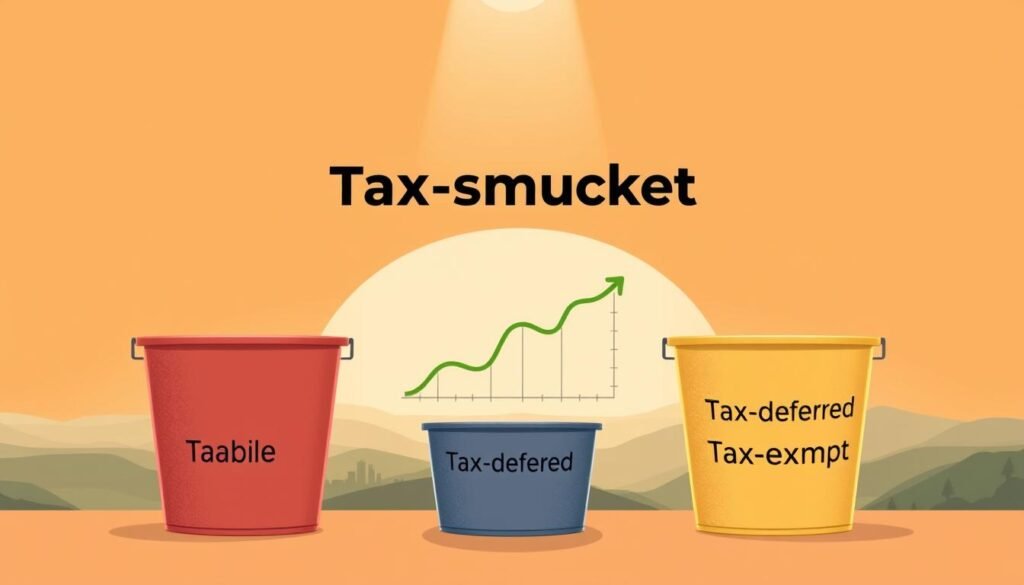
    Tax-smart buckets: place assets across accounts to maximize after-tax returns

    Treat every retirement account as a different tool: one sheds taxes now, another shelters gains later.

    Pre-tax accounts like Traditional IRAs and 401(k)s offer deductible contributions and tax-deferred growth. Withdrawals are taxed as ordinary income and usually face required minimum distributions (RMDs).

    Roth accounts use after-tax money. Qualified distributions are tax-free, and Roth IRAs avoid RMDs—helpful for legacy planning and tax control.

    A finely detailed illustration of "tax-smart buckets" against a warm, softly-lit background. In the foreground, three distinct buckets labeled "Taxable", "Tax-deferred", and "Tax-exempt" stand side-by-side, their contrasting colors and textures highlighting their unique financial characteristics. The middle ground features a stylized graph or chart, visualizing the different growth trajectories and tax implications of each bucket. The background depicts a serene landscape, perhaps rolling hills or a tranquil cityscape, conveying a sense of financial stability and long-term planning. Subtle lighting from above casts gentle shadows, adding depth and dimension to the overall composition.

    Taxable accounts and asset location basics

    Taxable brokerage accounts give flexibility. Long-term gains and qualified dividends often have lower rates. You can also harvest losses to offset gains.

    Place interest-heavy bond funds and REITs in tax-deferred accounts to avoid annual tax drag. Keep broad equity index funds in taxable accounts when feasible for cheaper turnover and preferential rates.

    • Map your buckets: Traditional for deferral, Roth for tax-free withdrawals, taxable for flexibility.
    • Consider an HSA if eligible — triple tax benefits for qualified medical costs.
    • Watch contribution limits and revisit asset location yearly or after tax law changes.
    Account Best assets to hold Why
    Traditional IRA / 401(k) Bond funds, high-interest assets Defers annual tax on interest and ordinary income at withdrawal
    Roth IRA / Roth 401(k) High-growth equities Tax-free growth and no RMDs for Roth IRAs
    Taxable brokerage Low-turnover index funds, municipal bonds (if appropriate) Preferential long-term gains, loss harvesting, flexible withdrawals

    Plan withdrawal sequencing and mix distributions to manage your tax rate in retirement. For practical tax-smart withdrawal tactics, see this guide to tax-savvy withdrawals.

    Life-stage playbook: adapting your IRA from your 20s to retirement

    Different decades of life call for clear but simple shifts in IRA allocations. Follow a stage-based plan to match your age, savings, and tolerance for market swings.

    Your 20s

    Lean toward stocks through broad index funds and ETFs to capture long-term compounding.

    Automate contributions and use dollar‑cost averaging. Keep a starter emergency fund so you won’t raid retirement savings.

    Your 30s–40s

    Add bonds to reduce volatility and protect progress. Keep saving automatically and raise your savings rate after pay increases.

    If you fund a 529, prioritize retirement first—there are loans for college but not for retirement.

    Pre-retirement

    Shift into higher-quality bonds and cash while keeping some stocks to guard against inflation.

    Validate your risk tolerance with stress tests and hold 1–3 years of expenses in short bonds or cash.

    In retirement

    Focus on capital preservation and steady income: Treasuries, investment‑grade corporates, and conservative dividend payers.

    Keep liquidity for healthcare and review beneficiary and estate details regularly.

    “Plan each stage so you trade panic for a repeatable rule set when markets move.”

    Stage Primary focus Typical allocation
    20s Compounding, equity exposure 70–90% stocks, 10–30% bonds/cash
    30s–40s Growth + volatility control 60–75% stocks, 25–40% bonds/cash
    Pre-retirement Income and protection 40–60% stocks, 40–60% bonds/cash
    Retirement Preserve capital, generate income 20–50% stocks, 50–80% bonds/cash

    Keep it on track: automate contributions, review annually, and rebalance with discipline

    A disciplined routine—regular deposits and scheduled reviews—keeps your plan on track over decades. Automate contributions to your ira so you build wealth without second-guessing each transfer.

    Review cadence: check your accounts at least once a year and after major life events or large market moves. Annual reviews let you confirm that your allocation still matches goals and tolerance.

    Rebalancing triggers: pick time‑based checks (for example, once per year) or drift‑based rules (rebalance when an asset class shifts by ~5 percentage points).

    Practical rules to follow

    • When rebalancing, sell overweight positions and add to underweights to restore asset allocation.
    • Direct new money to underweighted funds or etfs to reduce trading and cost.
    • Keep a small cash buffer to avoid forced sales during downturns.
    • Watch transaction costs, bid‑ask spreads, and tax effects in taxable accounts.
    • If unsure, seek a fiduciary advisor to set thresholds and review your trade list.

    “A rules-based process beats reacting to headlines; consistency protects portfolio outcomes.”

    Track results year over year to confirm rebalancing controls risk and preserves diversification. For additional strategies on keeping a retirement portfolio steady, see this practical guide.

    How do I balance growth with security in my IRA? Withdrawal order, RMDs, and Roth moves

    A clear withdrawal order helps manage taxes, required distributions, and portfolio risk.

    Start with maturing cash sources such as CDs or bond ladder principal for planned spending. This preserves invested funds and avoids taxable sales during down markets.

    Required minimum distributions matter. The first RMD is due by April 1 of the year after your RMD start date; later RMDs are due by December 31 each year. Calculate RMDs using the prior December 31 account value divided by the IRS life‑expectancy factor. Missing an RMD can trigger a 50% penalty on the shortfall.

    Consolidate IRAs to simplify RMDs; you may take the total IRA RMD from any one IRA. Note that each 401(k) requires its own RMD.

    Tax-smart order after RMDs: sell from taxable accounts next, favoring long‑term positions and harvesting losses to offset gains. Then use tax‑deferred accounts; leave Roth IRA funds for last to protect tax‑free income and estate flexibility.

    Roth conversions can lower future RMDs and create tax‑free income, but they raise taxable income in the conversion year. If you convert, pay the tax from non‑IRA money when possible and consult an advisor before large moves.

    “Coordinate withdrawals with rebalancing: trim overweights in good years and rely on cash or bonds during downturns.”

    Conclusion

    Consistent habits and tax-aware account choices keep portfolios working over decades. Set a sensible asset allocation, automate contributions, and plan rebalances so market noise does not steer your savings. Keep a small cash buffer and clear position limits to control risk.

    Use broad funds and ETFs for low-cost diversification across stocks, bonds, and cash. Place interest-heavy holdings where tax rules bite less, and coordinate across accounts to protect returns.

    Follow a disciplined withdrawal order in retirement: use maturing cash and short bonds, meet RMDs, draw from taxable then tax-deferred accounts, and preserve Roth for last. Adjust allocation slowly by life stage and review yearly.

    When choices feel large, consult a fiduciary advisor and a tax professional. The steady way—diversified, cost-aware, and tax-smart—gives investors the best chance to reach retirement goals.

    FAQ

    What does balancing growth and security mean for IRA investors today?

    It means choosing a mix of assets that seeks long-term gains while limiting losses that can derail retirement plans. That mix depends on age, savings rate, retirement date, and risk tolerance. The goal is growth enough to outpace inflation while keeping volatility manageable so withdrawals remain predictable.

    Which inputs matter most when defining an IRA plan?

    Key inputs are your age, income, current savings, planned retirement date, and risk tolerance. These determine asset allocation, contribution levels, and withdrawal targets. Use a realistic savings rate and set guardrails like an emergency fund to avoid forced selling in downturns.

    How should I set a withdrawal target for retirement?

    Many retirees aim near a 4% initial withdrawal rate as a starting rule of thumb. Adjust that target based on portfolio size, expected longevity, spending needs, and market conditions. Build flexibility into spending and plan for phased draws in early retirement.

    What roles do stocks, bonds, and cash play in an IRA?

    Stocks drive growth and help fight inflation. Bonds provide income and lower portfolio volatility. Cash offers liquidity and capital preservation for short-term needs. The right mix balances expected returns against risk and time horizon.

    How can I avoid concentration risk in a retirement account?

    Use position limits like a 5% rule for single holdings and diversify across sectors, market caps, and geographies. Consider broad index funds and ETFs to spread exposure and reduce single-stock or sector concentration that can hurt long-term outcomes.

    Are target-date or target-risk funds a good option?

    Yes, they provide a set‑and‑adjust approach that automatically shifts allocation over time. Target-date funds simplify rebalancing and are convenient for investors who prefer a hands‑off strategy. Check glidepath, fees, and underlying fund quality.

    How should I diversify across asset classes and vehicles?

    Build a core using U.S. and international equities, high‑quality bonds, and cash. Layer tactical exposure like municipal bonds, dividend payers, or real‑asset funds as needed for income or inflation protection. Use IRAs, 401(k)s, and taxable accounts together for tax efficiency.

    When are municipal bonds or dividend stocks appropriate?

    Consider municipal bonds for tax‑advantaged income if you’re in a higher tax bracket and hold them in taxable accounts. Dividend payers suit investors seeking yield, but evaluate payout sustainability. Avoid overloading any bucket with a single income source.

    How should I allocate assets across tax‑sheltered and taxable accounts?

    Place tax‑inefficient, income‑generating assets (like taxable bonds) in tax‑deferred accounts such as Traditional IRAs. Hold growth assets that generate capital gains in taxable accounts. Use Roth IRAs for investments you expect to grow tax‑free and for flexibility in retirement.

    What are the tax differences between Traditional and Roth accounts?

    Traditional accounts give an upfront tax deferral; withdrawals are taxed as ordinary income. Roth accounts use after‑tax dollars but offer tax‑free qualified withdrawals and no required minimum distributions. Choose based on current tax rate vs. expected rate in retirement.

    How should asset location change by life stage?

    In your 20s, favor equities and Roth contributions if possible. In your 30s–40s, add bonds and build an emergency fund. Pre‑retirement, shift toward income and lower volatility while keeping some stocks for inflation. In retirement, prioritize preservation, income, and liquidity for healthcare.

    What review cadence and rebalancing rules work best?

    Review annually and after major life events or market shocks. Use time‑based rebalancing (e.g., yearly) or drift triggers (e.g., 5% drift from target). Rebalance with tax and cash needs in mind, trimming winners to buy laggards and maintain discipline.

    What’s the recommended withdrawal sequence across accounts?

    A common sequence: use maturing short‑term cash and taxable accounts first, take required minimum distributions when due, then withdraw from tax‑deferred accounts, and use Roth balances last to preserve tax flexibility. Tailor sequencing to your tax picture and spending needs.

    What are RMD essentials I should know?

    Required minimum distributions have timing rules, penalties for missed RMDs, and are based on life expectancy tables and account balances. Consolidating similar accounts can simplify RMD calculations. Plan withdrawals to avoid large tax spikes in a single year.

    Which tax tactics can improve after‑tax returns?

    Harvest tax losses in taxable accounts, favor long‑term capital gains, and align trades with rebalancing to limit taxable events. Manage distributions to avoid bumping into higher tax brackets and coordinate Roth conversions when rates or income are favorable.

    Should I consider Roth conversions, and when do they make sense?

    Roth conversions make sense when you expect higher future tax rates, have room in lower tax brackets, or want to reduce future RMDs. They create an upfront tax bill, so time conversions during low‑income years or market dips to buy tax‑free growth efficiently.